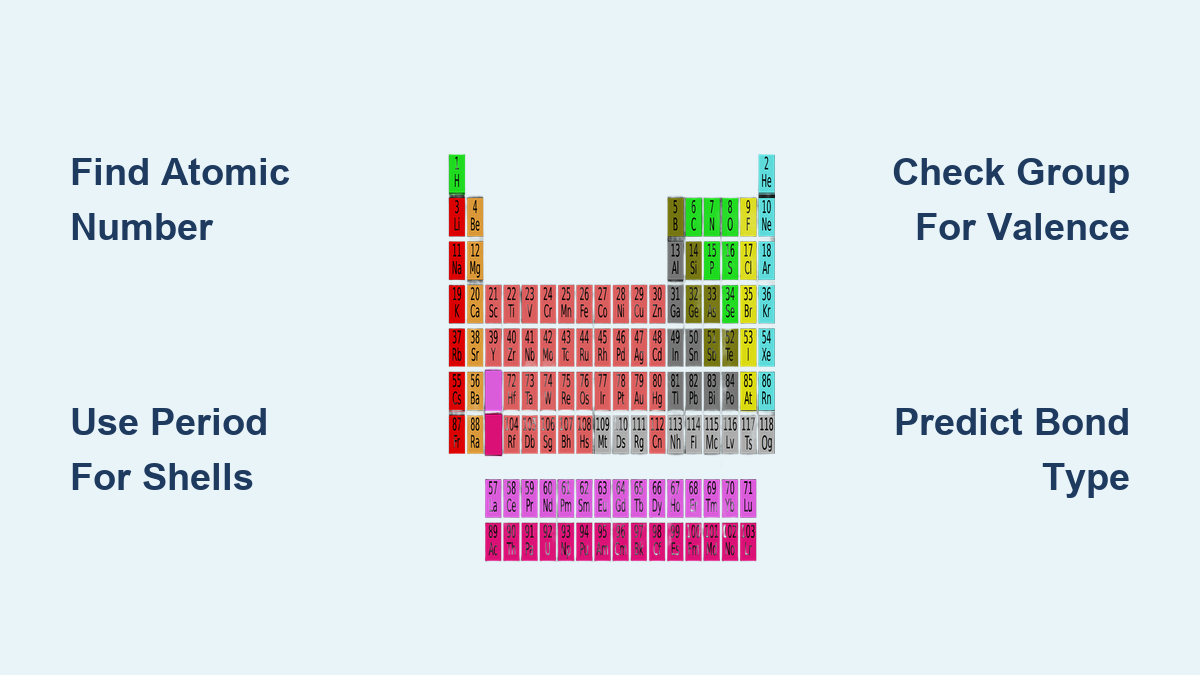
How to Use the Periodic Table Guide
The periodic table looks like a simple chart, but it contains powerful information that lets you predict how elements will behave before you ever mix them together. By understanding its structure and patterns, you can determine an element’s properties, anticipate chemical reactions, and solve chemistry problems without memorizing every detail. This guide walks you through exactly how to use the periodic table to extract meaningful data and make accurate predictions about chemical behavior.
Read Element Information Correctly

Each element box on the periodic table contains three essential pieces of information that form the foundation for all chemical calculations.
Identify Atomic Number, Symbol, and Mass
Every element tile displays key data in the same positions. Learning to read these values quickly is the first skill you need.
- Atomic number (top): This whole number equals the number of protons in the nucleus. It defines what the element is. Carbon always has 6 protons.
- Chemical symbol (center): A one or two-letter code where the first letter is uppercase and the second is lowercase. Examples include O for oxygen, Fe for iron, and Na for sodium.
- Atomic mass (bottom): A decimal value representing the weighted average mass of all natural isotopes, measured in atomic mass units. For basic calculations, round this to the nearest whole number.
Pro tip: When you see 12.01 under carbon, use 12 for neutron calculations. Save precision for advanced work involving specific isotopes.
Calculate Protons, Neutrons, and Electrons
With just the atomic number and mass, you can determine the complete subatomic particle count for any element.
- Protons = Atomic number
- Electrons = Atomic number (in neutral atoms)
- Neutrons = Rounded atomic mass – Atomic number
Example: Nitrogen (N)
Atomic number: 7
Atomic mass: 14.01 rounds to 14
Neutrons = 14 – 7 = 7
Example: Magnesium (Mg)
Atomic number: 12
Atomic mass: 24.31 rounds to 24
Neutrons = 24 – 12 = 12
Watch out: Ions have different electron counts. A Mg²⁺ ion has 12 protons but only 10 electrons.
Use Periods to Find Electron Shells
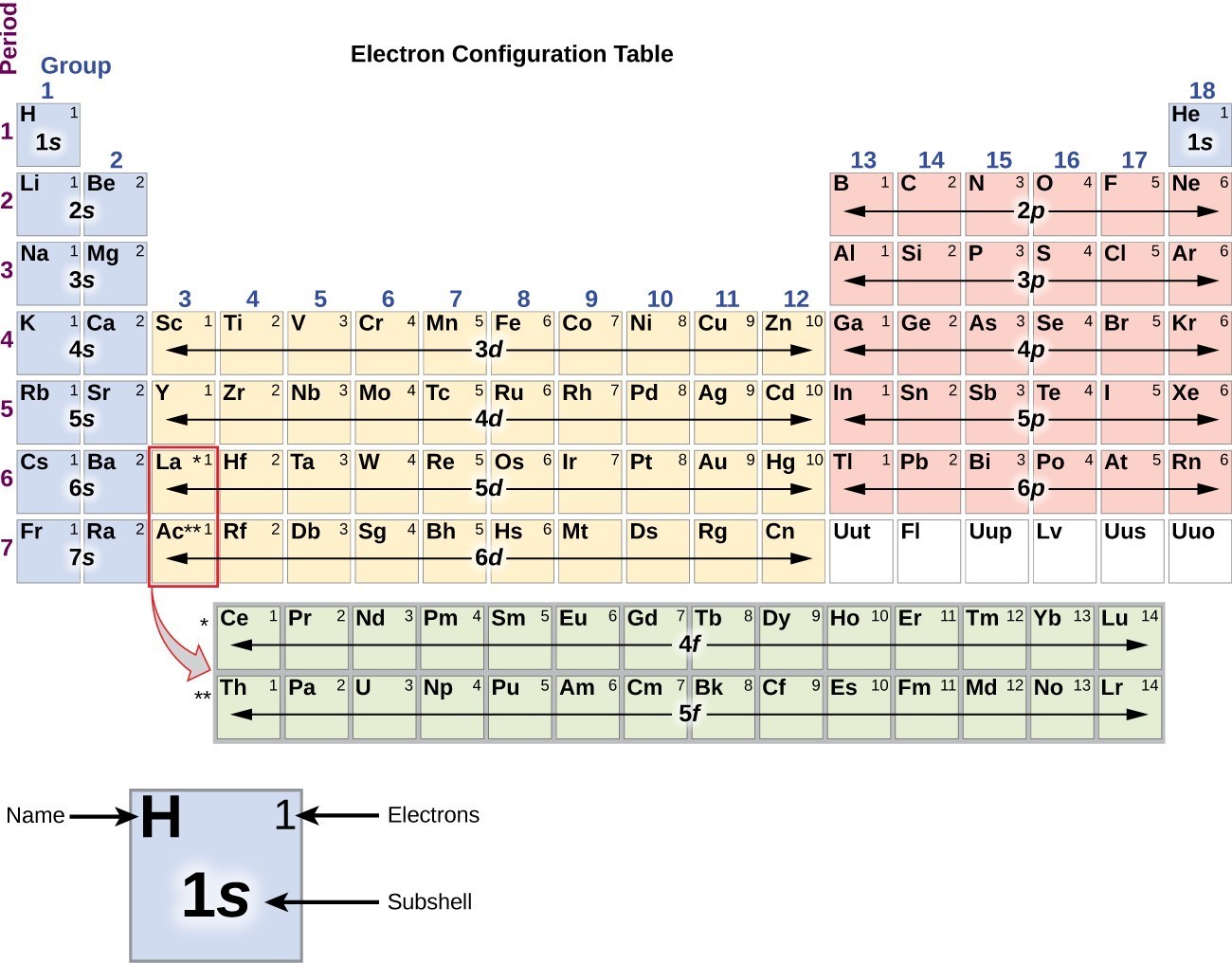
The horizontal rows of the periodic table are called periods, and they directly reveal how many electron shells an atom possesses.
Period Number Equals Energy Levels
There are 7 periods total, and each period number matches the number of electron shells in its elements.
- Period 1: 1 shell (hydrogen and helium)
- Period 2: 2 shells (lithium through neon)
- Period 3: 3 shells (sodium through argon)
- Period 6: 6 shells (includes cesium through radon, plus lanthanides)
Example: Sulfur (S) sits in Period 3, meaning it has 3 electron shells surrounding its nucleus.
Track Left-to-Right Trends Across a Period
As you move from left to right across any period, several predictable changes occur.
- Atomic number increases with each step
- Elements shift gradually from metals on the left to non-metals on the right
- Atoms become smaller due to increasing nuclear charge pulling electrons closer
- Reactivity patterns change based on how easily atoms gain or lose electrons
Quick visual cue: Metals dominate the left side, non-metals cluster on the right, with metalloids forming a diagonal staircase between them.
Group Position Reveals Valence Electrons

Vertical columns are called groups, and they tell you exactly how many valence electrons an element has in its outer shell.
Groups 1 Through 18 Indicate Chemical Behavior
Modern tables number groups 1 to 18. Elements in the same group share identical valence electron counts and therefore exhibit similar chemical properties.
| Group | Valence Electrons | Common Ion | Example |
|---|---|---|---|
| 1 | 1 | +1 | Na⁺ |
| 2 | 2 | +2 | Mg²⁺ |
| 13 | 3 | +3 | Al³⁺ |
| 14 | 4 | ±4 | C (covalent) |
| 15 | 5 | –3 | N³⁻ |
| 16 | 6 | –2 | O²⁻ |
| 17 | 7 | –1 | Cl⁻ |
| 18 | 8 (or 2 for He) | 0 (inert) | Ne |
Note: Helium has only 2 electrons but is stable and grouped with noble gases because its first shell is completely full.
Predict Reactivity by Group
Alkali Metals (Group 1) are soft, shiny metals that react violently with water. They lose 1 electron to form +1 ions, and reactivity increases as you move down the group.
Alkaline Earth Metals (Group 2) are harder than Group 1 metals and form +2 ions. They react more slowly with water, with magnesium requiring heat to react.
Halogens (Group 17) are highly reactive non-metals that gain 1 electron to form –1 ions. Reactivity decreases as you move down the group, making fluorine the most reactive halogen.
Noble Gases (Group 18) have full outer shells, making them extremely stable and non-reactive. They appear in neon signs and serve as protective shields in welding.
Classify Elements by Type
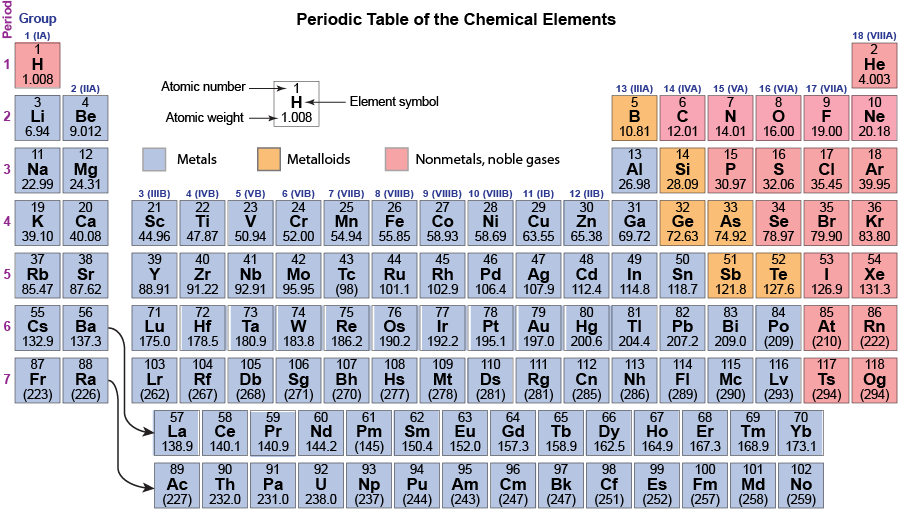
The periodic table divides all elements into three main categories, each with distinct physical and chemical properties.
Identify Metals on the Left
Metals occupy approximately 80% of the table, primarily on the left and center sections.
- Shiny luster when polished
- Solid at room temperature (except mercury, which is liquid)
- Malleable and ductile
- Excellent conductors of heat and electricity
- Tend to lose electrons and form positive ions
Subcategories include: alkali metals (Group 1), alkaline earth metals (Group 2), and transition metals (Groups 3-12) known for colorful compounds and variable charges.
Spot Non-Metals on the Right
Non-metals cluster on the upper right side of the table, excluding hydrogen.
- Generally dull in appearance
- Brittle when solid
- Poor conductors of heat and electricity
- Tend to gain electrons and form negative ions
Common examples: oxygen essential for respiration, carbon forming the backbone of organic molecules, and sulfur found in proteins.
Locate Metalloids Along the Staircase
Metalloids lie along the zigzag line from boron to tellurium.
The six metalloids are: boron, silicon, germanium, arsenic, antimony, and tellurium.
These elements display mixed properties, acting as semiconductors that conduct electricity under certain conditions. This makes silicon critical for computer chips and electronics.
Understand Electron Configuration Patterns
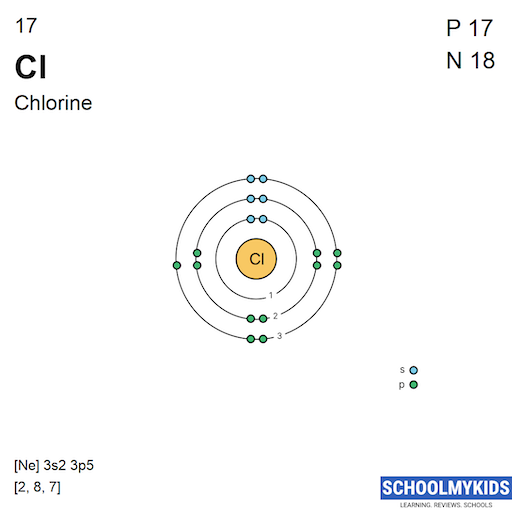
Electron arrangement explains why elements behave the way they do, and the periodic table makes this pattern visible.
Determine Shell Distribution
Electrons fill shells according to specific capacity rules.
- Shell 1 holds maximum 2 electrons
- Shell 2 holds maximum 8 electrons
- Shell 3 holds more, but fills to 8 for early elements
Write configuration as numbers per shell, separated by commas.
Example: Aluminum (Al)
Atomic number = 13 means 13 electrons
Distribution: 2 in first shell, 8 in second, 3 in third
Configuration: 2, 8, 3
This gives 3 valence electrons, placing aluminum in Group 13.
Example: Chlorine (Cl)
Atomic number = 17 means 17 electrons
Configuration: 2, 8, 7
This gives 7 valence electrons, placing chlorine in Group 17.
Apply the Octet Rule
Atoms react to achieve 8 valence electrons, mimicking the stable configuration of noble gases.
- Metals lose electrons to empty their outer shell and expose the full shell beneath
- Non-metals gain electrons to complete their outer shell
- Covalent sharing occurs when both atoms need electrons, as in water (H₂O)
Example: Sodium + Chlorine → Salt
Na (2,8,1) loses 1 electron → Na⁺ (2,8) like neon
Cl (2,8,7) gains 1 electron → Cl⁻ (2,8,8) like argon
Opposite charges attract, forming the ionic bond in NaCl.
Exception: Hydrogen and helium follow the duet rule, achieving stability with just 2 electrons.
Predict Chemical Behavior Fast

Use position on the table to make quick predictions without looking up individual properties.
Guess Ion Charge from Group Number
- Group 1 → +1 ion
- Group 2 → +2 ion
- Group 13 → +3 ion
- Group 15 → –3 ion
- Group 16 → –2 ion
- Group 17 → –1 ion
- Group 18 → no ion formed
Shortcut: For main group elements, charge equals group number minus 10 (works for groups 13-17).
Estimate Reactivity Trends
- Down a group: Reactivity increases for metals (easier to lose electrons), decreases for non-metals (harder to gain electrons)
- Across a period: Metallic character decreases while non-metallic character increases
Example: Fluorine at the top of Group 17 is more reactive than iodine at the bottom. Cesium at the bottom of Group 1 is more reactive than lithium at the top.
Anticipate Bond Type
- Metal + Non-metal → Ionic bond (electron transfer)
- Non-metal + Non-metal → Covalent bond (electron sharing)
- Metal + Metal → Metallic bond (electron sea)
Example: Magnesium (metal) + Oxygen (non-metal) produces MgO with ionic bonding. Carbon (non-metal) + Oxygen (non-metal) produces CO₂ with covalent bonding.
Master Transition Metals and Exceptions
The middle block (Groups 3-12) behaves differently from the main groups and requires special attention.
Recognize Variable Oxidation States
Unlike main group elements, transition metals commonly form multiple stable ions.
| Element | Common Ions |
|---|---|
| Iron (Fe) | Fe²⁺, Fe³⁺ |
| Copper (Cu) | Cu⁺, Cu²⁺ |
| Manganese (Mn) | Mn²⁺, Mn³⁺, Mn⁴⁺, Mn⁷⁺ |
This happens because electrons from inner d-orbitals can also participate in bonding.
Know Key Transition Metal Uses
- Iron: Steel production and construction
- Copper: Electrical wiring and plumbing
- Zinc: Galvanizing to prevent rust
- Silver and gold: Jewelry and electronics
Note: Their symbols come from Latin names: Fe (ferrum), Cu (cuprum), Ag (argentum), Au (aurum).
Solve Problems Using the Table
Apply everything learned to locate elements and predict their properties.
Find an Element by Group and Period
Think of coordinates on a grid.
Example 1: Group 14, Period 3
3 electron shells, 4 valence electrons
Element: Silicon (Si)
Example 2: Group 2, Period 5
5 electron shells, 2 valence electrons
Element: Strontium (Sr)
Determine Unknown Element Properties
Given only position, predict behavior.
Scenario: An element sits in Group 16, Period 4.
- Name: Selenium (Se)
- Valence electrons: 6
- Likely ion: Se²⁻
- Type: Non-metal
- Reactivity: Less than oxygen and sulfur above it, more than tellurium below it
- Bonding: Forms covalent compounds like hydrogen selenide (H₂Se)
Decode Isotope Notation
Isotopes contain the same protons but different neutrons.
Example: Carbon-14
– Symbol: ¹⁴C
– Protons: 6 (always, by definition)
– Neutrons: 14 – 6 = 8
– Electrons: 6 (if neutral)
Compare to Carbon-12: 6 protons, 6 neutrons, making it lighter and more common in nature.
Frequently Asked Questions About Using the Periodic Table
What does the atomic number tell you about an element?
The atomic number indicates the exact number of protons in an element’s nucleus. This number defines the element’s identity and determines how many electrons it has in a neutral atom.
How do you find how many electron shells an element has?
Look at the period number. An element in Period 3 has 3 electron shells. This applies to all elements except the lanthanides and actinides, which are displayed separately.
Why do elements in the same group react similarly?
Elements in the same group have the same number of valence electrons in their outer shell. Since chemical reactions involve these valence electrons, elements with identical outer electron counts behave comparably.
What is the difference between metals and non-metals on the table?
Metals appear on the left and center, typically shiny and conductive. Non-metals appear on the right, usually dull and insulating. Metalloids straddle the dividing line between them.
How can you predict if a bond will be ionic or covalent?
Check the elements involved. A metal combined with a non-metal typically forms an ionic bond through electron transfer. Two non-metals typically form a covalent bond through electron sharing.
Why do transition metals have multiple ion charges?
Transition metals can lose electrons from their outer shell and from inner d-orbitals, allowing them to form several different stable ions with different charges.
Key Takeaways for Using the Periodic Table Effectively
The periodic table transforms from an intimidating chart into a powerful tool once you understand its underlying logic. Remember that the atomic number defines identity, period numbers reveal electron shells, and group numbers indicate valence electrons and likely ions. Use these three pieces of information to predict reactivity, anticipate bond types, and solve chemistry problems efficiently. The patterns embedded in this table let you understand all matter, from simple table salt to the silicon chips in your devices. Keep your periodic table handy, refer to it regularly, and let its structure guide your understanding of the material world.