How to Create a Cap Table: Step-by-Step Guide
You’ve incorporated your startup, brought on co-founders, and maybe closed a small angel round. Now what? One of the most critical and often overlooked early responsibilities is creating a capitalization table, or “cap table.” It’s not just a spreadsheet; it’s the legal and financial backbone of your company’s ownership structure.
A well-maintained cap table tells you exactly who owns what, how much each shareholder is entitled to in an exit, and how future funding rounds will dilute existing owners. Whether you’re issuing shares to founders, granting stock options to employees, or preparing for a Series A, your cap table is the single source of truth. In this guide, you’ll learn how to build a cap table from scratch, track different types of equity, calculate ownership percentages correctly, and avoid common mistakes that can cost time, money, and control.
Set Up Your Cap Table Foundation

Before adding investors or employees, start with the basics: your company’s initial equity framework.
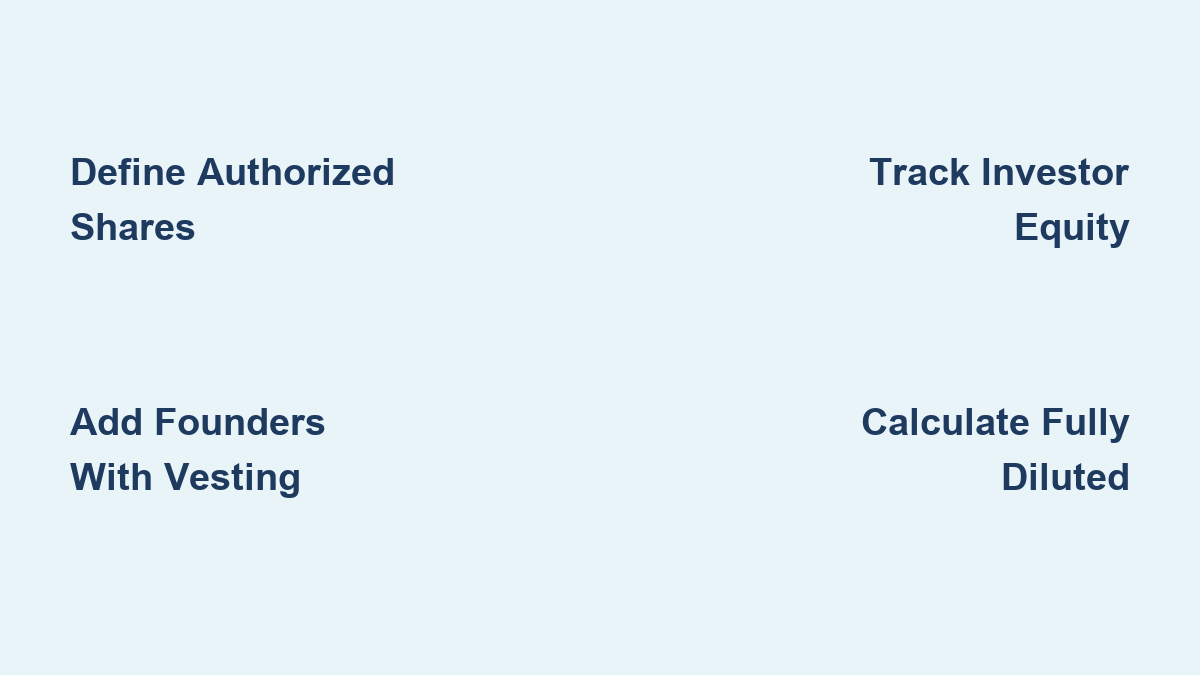
Define Authorized Shares First
Every corporation has a maximum number of shares it’s legally allowed to issue. This is called authorized shares. Early-stage startups typically authorize 10 million common shares to allow for easy division and future flexibility.
This doesn’t mean you issue all 10 million upfront. You only issue what’s needed, such as to founders. The rest remain unissued but available for future use, like employee options or investor rounds.
Pro Tip: Authorizing too few shares can trigger legal amendments later. 10 million is standard for U.S. C-corps.
Add Founders with Proper Vesting Schedules
List all founders and their agreed-upon equity split, whether that’s 60/40 or 50/50. But don’t stop there. Apply vesting schedules immediately to protect everyone involved.
Most founders receive equity subject to a four-year vesting schedule with a one-year cliff. No equity vests in the first year. After one year, 25% vests. The remaining 75% vests monthly over the next 36 months. This protects the company if a co-founder leaves early.
Warning: Issuing full shares without vesting is risky. Always use vesting agreements and reflect them in the cap table.
Choose Your Tracking Tool: Spreadsheet or Software
For pre-seed startups with just founders, Google Sheets or Excel works fine. But once you add investors, options, or convertible notes, consider switching to cap table software like Carta, Pulley, or Shareworks.
| Stage | Recommended Tool |
|---|---|
| Founders only | Google Sheets |
| Seed round + ESOP | Cap table software |
| Series A+ | Professional platform |
Spreadsheets are free and flexible but become error-prone as complexity grows. Software reduces risk, automates calculations, and integrates with legal and tax systems.
Add Investor Equity Correctly
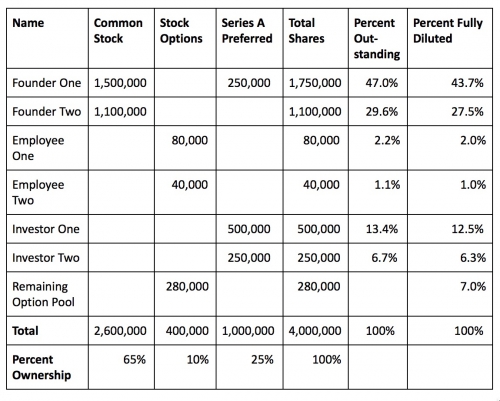
When you raise money, you issue shares to investors. This permanently changes your ownership structure and must be recorded accurately.
Classify Share Types Separately
Don’t lump all shares together. Investors usually get preferred stock, such as Series A Preferred, while founders and employees hold common stock. Preferred stock comes with special rights, including liquidation preference, anti-dilution protection, and board seats or veto rights.
Your cap table must clearly separate common stock, preferred stock by series, convertible notes, SAFEs, and warrants.
Visual Cue: Use color coding or separate tabs for each security type to maintain clarity.
Calculate Post-Money Ownership Correctly
When an investor puts in $1 million at a $4 million pre-money valuation, the math works like this. Post-money valuation equals $5 million. The investor ownership percentage equals $1 million divided by $5 million, which is 20%. Founders now own 80%, diluted from 100%.
Now calculate how many shares the investor gets. Pre-money shares equal 8,000,000. Price per share equals $4 million divided by 8 million, which is $0.50. Investor shares equal $1 million divided by $0.50, which is 2,000,000.
Update the cap table with these new totals.
Common Mistake: Forgetting that new shares increase the total count. Always recalculate percentages after each funding round.
Handle Convertible Notes and SAFEs Properly
Early investors often use convertible notes or SAFEs instead of buying shares outright. These instruments convert into equity during a priced round.
Record All Key Terms
For each note or SAFE, include the principal amount, valuation cap, and discount rate. These terms determine how many shares the investor gets when conversion happens.
Convert at the Next Equity Round
When you close a Series A, these instruments convert based on the more favorable price for the investor. Suppose the next round price per share is $1.00 and the SAFE has a 20% discount. Then the conversion price equals $1.00 multiplied by 0.80, which is $0.80.
If the SAFE was for $80,000, the shares issued equal $80,000 divided by $0.80, which is 100,000 shares. Now include those shares in the fully diluted cap table.
Pro Tip: Model conversions before closing the round to anticipate dilution impact.
Build and Track the Option Pool
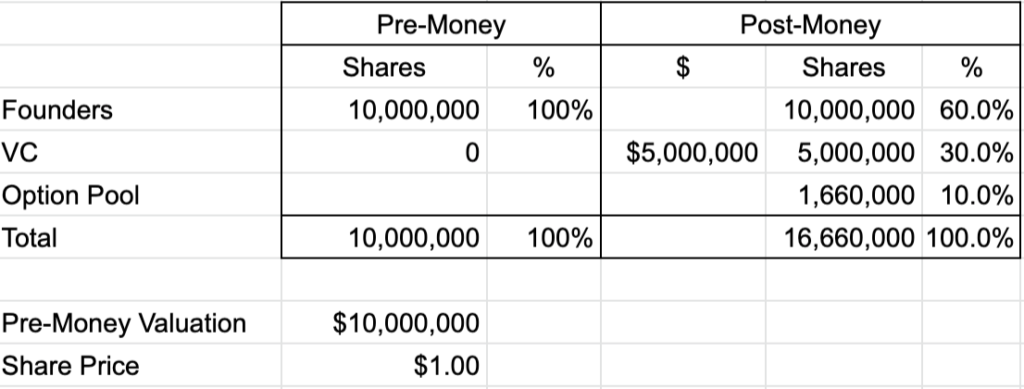
The Employee Stock Option Pool is a block of equity reserved for current and future employees. It’s a critical component that affects every funding round.
Size the Pool Strategically
Typical ESOP sizes vary by stage. Pre-seed companies usually have 10-12%. Seed rounds typically expand to 15-20%. Series A and beyond may expand further.
The key question is whether the pool is created pre-money or post-money, because this determines who bears the dilution cost.
Pre-Money vs. Post-Money Pool Creation
If you create a 15% pool before the investor’s money comes in, it reduces the pre-money value and increases founder dilution. The founders bear the full cost of the pool.
Under modern standards using post-money SAFEs, the pool is sized after the investment, so the new investor shares in the dilution.
Best Practice: Use post-money SAFEs to reduce founder dilution and distribute the pool creation cost more fairly.
Track Individual Grants Separately
The cap table should show the total pool size, granted options, and unallocated remaining options. Each employee grant should be tracked in an option ledger with grant date, strike price, vesting schedule, and expiration date.
Calculate Ownership: Undiluted vs. Fully Diluted
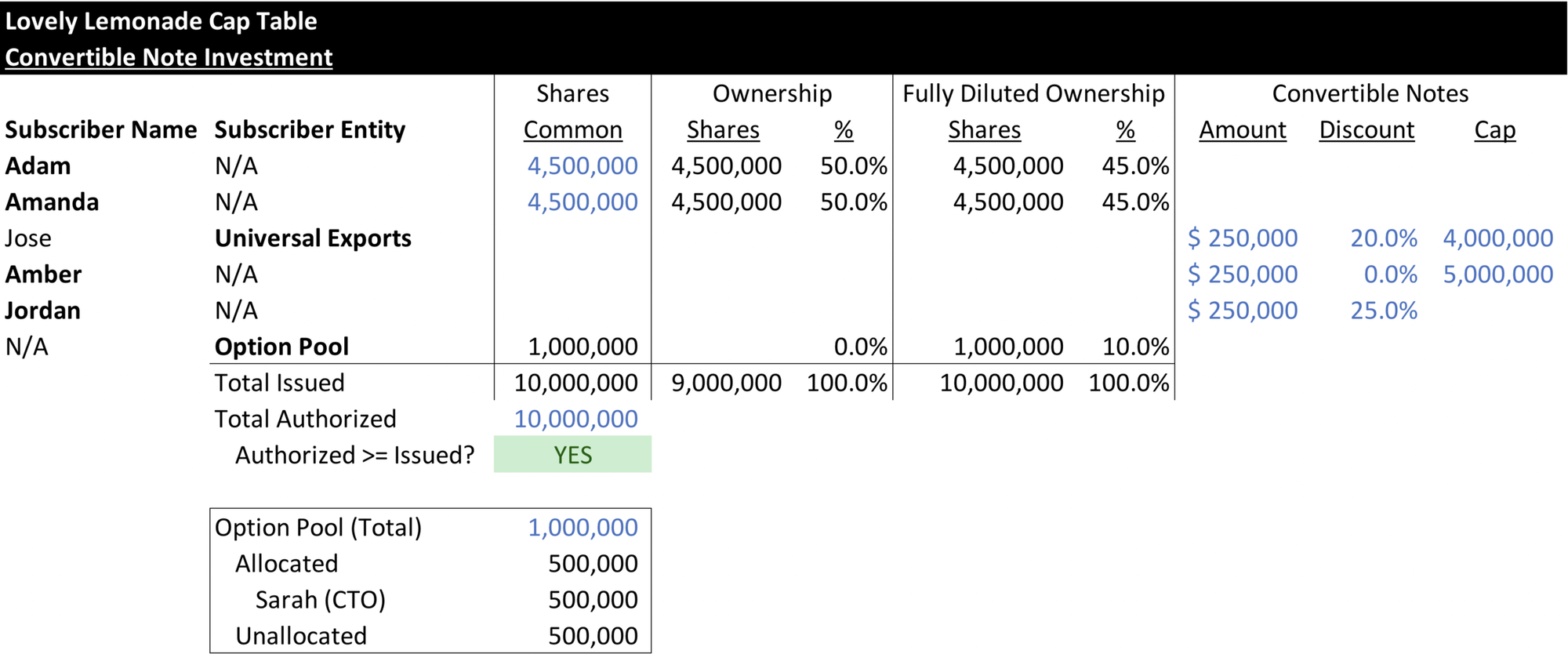
Many founders think they own more than they actually do because they ignore fully diluted ownership, which is the only number that matters for strategic planning.
Understanding Undiluted Ownership
Undiluted ownership only includes issued shares, meaning common stock and preferred stock currently held. It’s easy to calculate but can be misleading for decision-making.
Understanding Fully Diluted Ownership
Fully diluted ownership includes all potential shares. This means issued common and preferred plus all outstanding options, both vested and unvested, plus warrants and convertible notes and SAFEs assumed to convert.
The formula is straightforward. Your fully diluted ownership equals your shares plus your exercisable options, divided by total fully diluted shares.
Critical Rule: The sum of all fully diluted ownership percentages must equal exactly 100%. If it doesn’t, you’ve missed something in your calculations.
Maintain Accuracy Over Time
A cap table isn’t a one-time project. It’s a living document that must evolve with every equity event.
Update After Every Equity Event
Update immediately when a new hire gets stock options, an investor converts a SAFE, a founder exercises shares, an employee leaves with unvested options expiring, or a secondary sale occurs. Delaying updates leads to confusion and costly errors.
Use Date-Stamped Versions
Every version must be labeled with a specific date, such as “Cap Table as of April 15, 2025.” Keep a history of past versions because you may need to prove ownership at a specific point in time for tax, legal, or dispute resolution purposes.
Audit Formulas Regularly
Ensure percentage columns are linked to share counts, not hardcoded. Check that totals sum to 100%. Validate that fully diluted count includes all instruments.
Red Flag: If percentages don’t add up to 100%, there’s a data error somewhere.
Avoid Common Cap Table Mistakes
Even smart founders make costly errors. Here’s how to avoid the most frequent ones.
Mistake 1: Ignoring Fully Diluted Shares
Failing to account for unexercised options leads to surprise dilution. You might think you own 50%, but after all options vest, it drops to 35%. Always report and plan using fully diluted ownership.
Mistake 2: No Vesting for Founders
Giving full equity upfront means no protection if a co-founder quits after six months. Apply four-year vesting with a one-year cliff to all founder shares.
Mistake 3: Poor Recordkeeping
Misspelled names, wrong dates, or inconsistent share classes break the table’s legal validity. Standardize formatting, use full legal names, and double-check dates.
Mistake 4: Forgetting Tax Deadlines
Employees who exercise options must file an 83(b) election within 30 days to avoid high taxes. Track exercise dates and remind employees. Record elections in the cap table.
Mistake 5: Overlooking Secondary Sales
Private sales between investors or from founders to employees must be recorded, or you lose chain of title. Treat secondaries like any other equity event and update the cap table accordingly.
Use Cap Tables for Strategic Planning
Your cap table isn’t just for compliance. It’s a strategic tool that informs major decisions.
Model Future Funding Rounds
Before signing term sheets, simulate the round. How much dilution will you take? What will your ownership be post-money? How does the option pool affect dilution? Cap table software lets you run these models instantly.
Run Waterfall Analyses for Exits
In an acquisition, who gets paid first? Not always the biggest shareholder. Use a waterfall analysis to project payouts. Pay off debts and transaction costs first. Then preferred shareholders get their liquidation preference. Remaining proceeds split among all shareholders on a pro-rata basis.
Sometimes a 10% preferred holder gets more than a 30% common holder in a low-exit scenario because ownership percentage doesn’t equal payout percentage due to preferences.
Prepare for Exit or IPO
At exit or IPO, your cap table must be fully audited, fully diluted, and legally verified. All unexercised options, warrants, and convertible instruments must be accounted for.
When to Transition to Professional Tools
Eventually, spreadsheets become too risky. Upgrade when you have more than 20 shareholders, multiple option grants per month, complex financing structures, or are preparing for audit or IPO.
Benefits of cap table platforms include real-time ownership tracking, automated vesting and 409A valuations, investor portals, ASC 718 reporting for accounting, and legal document integration. They reduce errors, save time, and build investor confidence.
Cost vs. Risk: Yes, software costs money, but a cap table error can cost millions in lost equity or legal battles.
Frequently Asked Questions About Creating a Cap Table
What is a cap table and why do I need one?
A cap table is a spreadsheet that tracks who owns what in your company. It records all equity securities including common shares, preferred shares, options, and convertible instruments. You need one to track ownership, plan fundraising, and ensure accurate distribution of proceeds during exits.
When should I create my first cap table?
Create your cap table when you incorporate the company. List founders and their initial share allocations with vesting schedules. This establishes the foundation for all future equity tracking.
What’s the difference between undiluted and fully diluted ownership?
Undiluted ownership includes only shares currently issued. Fully diluted ownership includes all shares plus all possible conversions, such as unexercised options, warrants, and convertible notes. Fully diluted is what matters for strategic planning.
How do I calculate ownership percentage after a funding round?
Divide the investor’s investment by the post-money valuation to get their ownership percentage. Subtract this from 100% to find existing shareholders’ combined ownership. Then calculate individual ownership by dividing each person’s shares by the total post-money shares.
How does the option pool affect founder dilution?
The option pool creation timing matters enormously. A pre-money pool reduces the pre-money valuation, increasing founder dilution. A post-money pool shares that dilution with new investors. Always negotiate for post-money pool creation when possible.
What happens to my cap table during an acquisition?
During acquisition, the waterfall analysis determines payout order. Preferred shareholders get paid first based on their liquidation preference. Common shareholders receive remaining proceeds pro-rata. Your cap table must be fully updated and audited before closing.
Key Takeaways for Building Your Cap Table
Creating a cap table is one of the most important responsibilities as a founder. It defines ownership, enables fundraising, protects your team, and ensures a smooth exit.
Start simple but start right. Use vesting schedules for all equity grants, track all securities including convertible instruments, calculate fully diluted ownership for every decision, and update religiously after every equity event.
Whether you use a spreadsheet or specialized software, accuracy is non-negotiable. Your cap table is not just data. It’s the DNA of your company’s financial future.
Next Steps: Draft your founder cap table today, set up vesting agreements, consult a startup lawyer to review equity grants, and explore free cap table templates from Y Combinator or Carta. Get it right now, and you’ll avoid painful corrections and expensive surprises down the road.