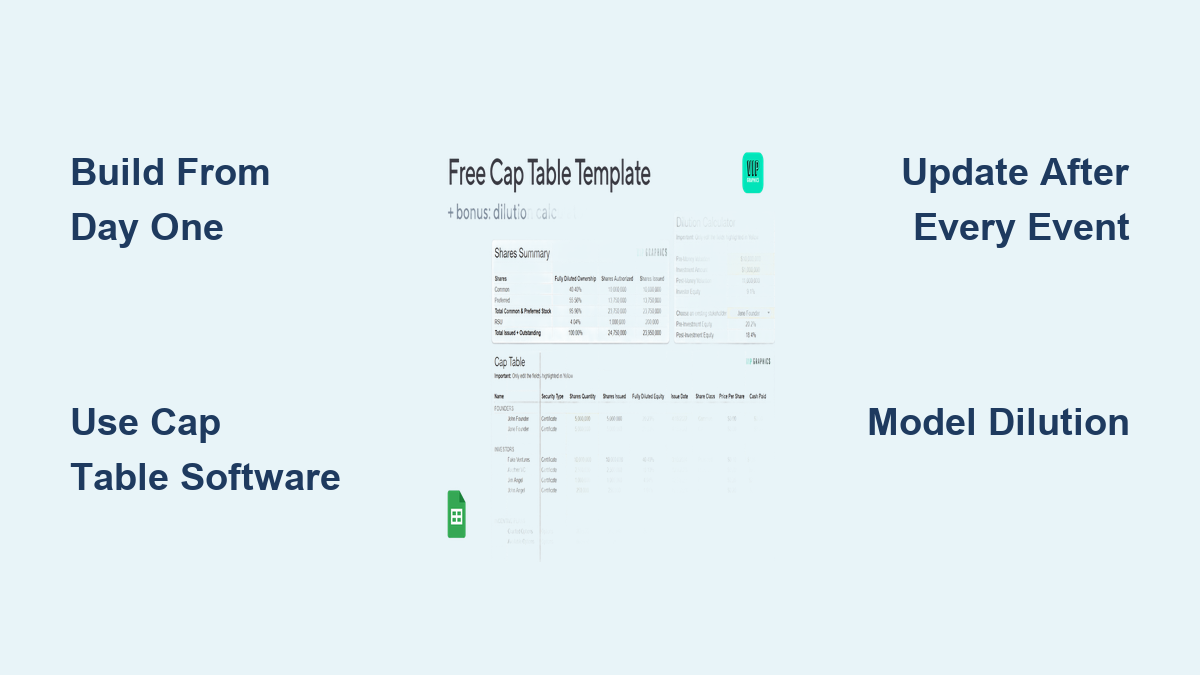
How to Manage a Cap Table: Quick Steps
You’ve just closed your first funding round or granted equity to your first key hire. Exciting times. But now comes a critical, often overlooked task: learning how to manage a cap table. A capitalization table is far more than a spreadsheet. It tracks exactly who owns what in your company, recording equity, dilution, valuations, and rights across founders, investors, and employees.
In this guide, you’ll learn how to build a clean cap table from day one, choose the right software, maintain accuracy through every equity event, model fundraising scenarios, and prepare for due diligence. Whether you’re bootstrapped or pre-Series A, these actionable steps will keep your ownership structure clear, compliant, and investor-ready.
Build Your Cap Table Step by Step

Your cap table becomes the single source of truth for all equity decisions. Setting it up correctly from incorporation prevents costly errors down the road.
Document Founders’ Equity Immediately
Record the initial split between founders right after incorporation. List each founder’s name, role, number of common shares, and ownership percentage. If shares are subject to a four-year vesting schedule with a one-year cliff, include that detail directly in the cap table.
For U.S. companies, founders receiving restricted stock must file an 83(b) election within 30 days of grant. This locks in tax liability at the time of grant rather than vesting, which saves significant money if the company’s value grows. Skip this step, and you risk a large tax bill later.
Never assume verbal agreements hold. If one founder contributed more IP or time, reflect that in the equity split and get it approved by the board.
Add Investor Equity Correctly
When investors come in, record the full details including share class, number of shares issued, price per share, total investment amount, liquidation preference, and voting rights. Preferred stock often includes investor protections like anti-dilution clauses or board seats, so keep these terms linked to the cap table.
If you issued a SAFE or convertible note, do not treat it as equity yet. Track it separately with its valuation cap and discount rate. It only converts during a priced round.
Create the Employee Option Pool
Reserve shares for future hires by establishing an employee stock option pool. At Series A, a typical pool is 14% of post-money shares, growing to 20% at later stages.
Add the pool as a line item on your cap table under common stock reserved. Option holders are not listed individually until they exercise. But the pool’s existence reduces everyone’s ownership on a fully diluted basis, so model this impact early.
Size the pool wisely. Too small, and you will need to refresh it, which dilutes existing shareholders again. Too large, and investors may push back.
Choose the Right Cap Table Software
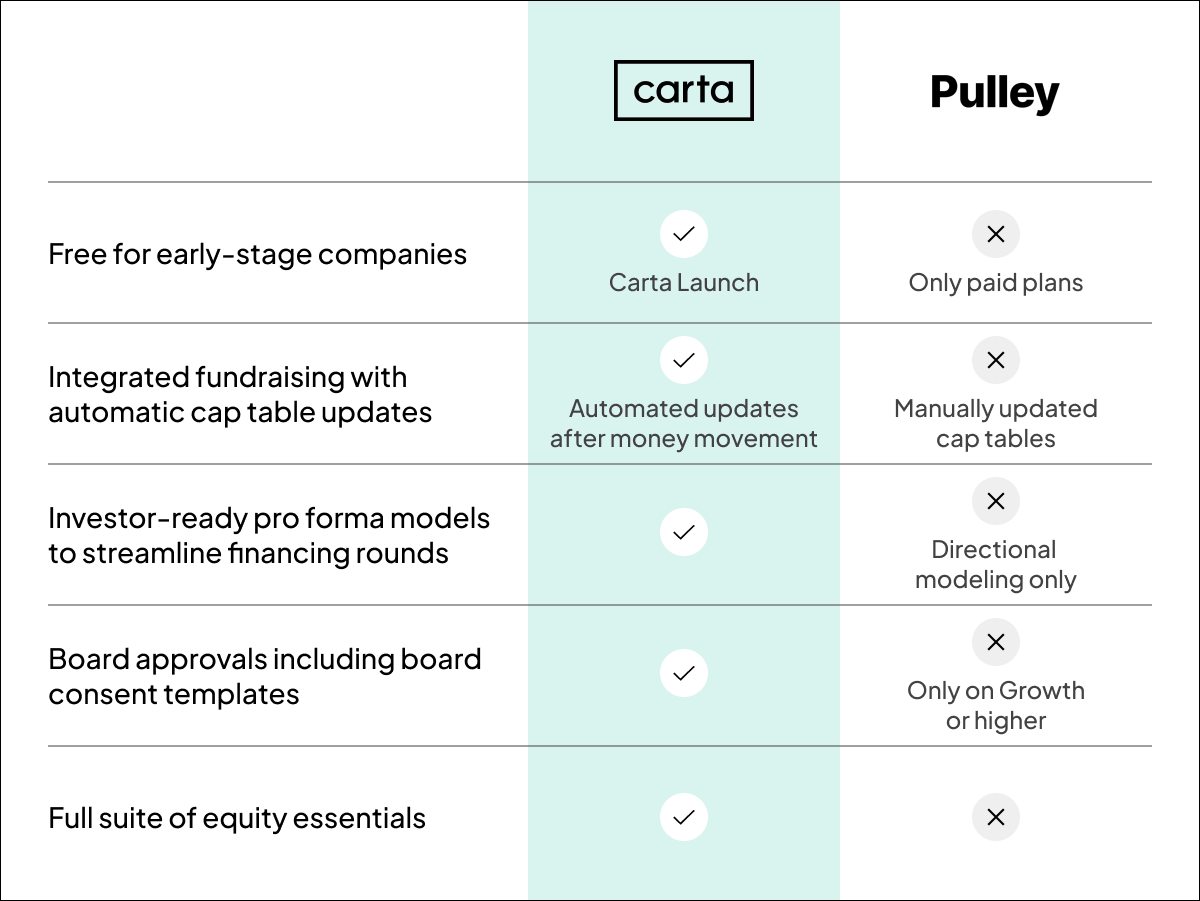
Why Spreadsheets Fail
Early startups often use Excel or Google Sheets. But spreadsheets are error-prone, insecure, and unscalable. A single formula mistake can misstate ownership by 5% or more. Version control issues arise when founders, lawyers, and investors all edit different files.
Worse, spreadsheets cannot auto-calculate dilution, model exits, or generate compliance reports. They lack audit trails, role-based access, and integration with 409A valuations.
If you are using vesting schedules, SAFEs, or planning a priced round, migrate off spreadsheets now.
Top Platforms Compared
| Platform | Best For | Pricing | Key Strengths |
|---|---|---|---|
| Cake Equity | Seed to Series A (US) | $1,000/year (25 stakeholders) | Transparent pricing, built-in 409A, employee app |
| Carta | Series A to IPO | Quote-based | Full suite, investor reporting, global reach |
| Pulley | Early-stage (YC-backed) | ~$1,200/year | Fundraising modeling, SAFE tracking |
| SeedLegals | UK Startups | Membership-based | Legal doc automation, Companies House filings |
| Ledgy | EU/Global Teams | ~€900/year | Cross-border compliance, multi-currency |
| Shareworks | Late-stage/IPO | Enterprise | Institutional-grade, complex global plans |
For most startups, Cake Equity or Pulley offers the best balance of usability and features. UK companies should start with SeedLegals. If you are near IPO, Shareworks or Carta becomes essential.
Look for fast onboarding, role-based access, exportable data, free migration support, and built-in 409A and compliance tools.
Keep Your Cap Table Accurate and Compliant
Your cap table is a living document that requires ongoing attention. Updates must happen immediately after every equity event.
Update After Every Equity Event
Update your cap table immediately after new equity grants, option exercises, share transfers, SAFE or note conversions, and funding rounds. Delaying updates leads to confusion. If an employee exercises options, their shares must appear instantly. If a founder leaves and forfeits unvested stock, adjust the table and notify the board.
Run Quarterly Audits
Even with software, errors creep in. Every quarter, reconcile cap table data with board resolutions, verify shareholder contact details, confirm 83(b) elections were filed, and check 409A valuation status. An audit-ready cap table prevents deal-killing surprises during due diligence.
Track Key Compliance Requirements
Cap table management is not optional. U.S. startups must conduct annual 409A valuations to set fair market value for option pricing, file Form 3921 for ISO exercises, maintain QSBS eligibility for tax-free gains, and honor Rule 701 limits on unregistered equity grants.
Use software with automated compliance features. Manual tracking risks penalties and disqualifies tax benefits.
Model Fundraising Scenarios and Dilution
:max_bytes(150000):strip_icc()/dotdash_Final_Pre_Money_vs_Post_Money_Whats_the_Difference_Sep_2020-01-1cbfad4529204bc8a9170f036cb0c133.jpg)
Before taking a term sheet, model how the round impacts ownership. Understanding dilution math is non-negotiable.
Forecast Dilution from New Rounds
Ask the right questions before a funding round. What is the pre-money valuation? How many new shares will be issued? What size option pool refresh is required?
For example, if founders own 70% pre-round, new investors take 20%, and the option pool expands by 10%, founders now own 56% post-money. Misjudge dilution, and you lose control of your company.
Size the Option Pool Strategically
Investors often demand a pre-funded option pool, meaning new shares are created before their investment, diluting founders more than investors.
Say you raise $5 million at $20 million pre-money. Without a pool refresh, founders are diluted 20%. With a 15% pool added pre-money, founders are diluted about 28%. Negotiate to add the pool post-money or limit its size based on hiring plans. Benchmark data shows most Series A companies use 12% to 16%.
Run Exit Waterfall Analysis
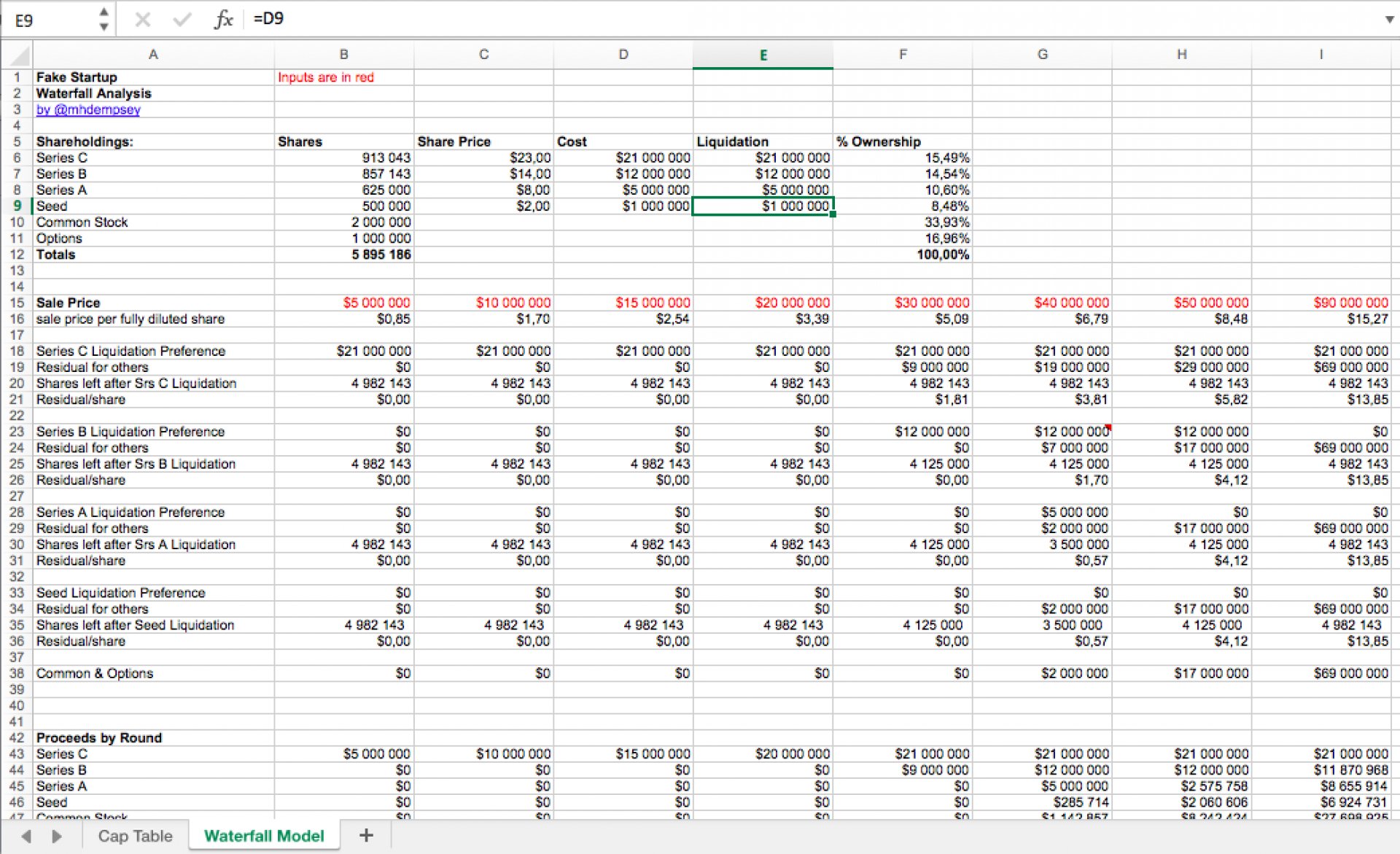
Use your cap table to model payouts in an acquisition. A $100 million exit does not mean equal splits. Preferred stockholders get paid first.
For example, if $50 million was raised at 1x liquidation preference and the acquisition is $100 million, the first $50 million goes to investors. The remaining $50 million splits among all shareholders. With participating preferred, investors get their $50 million back and a pro-rata share of the rest, drastically reducing founder returns.
Run these models early. Know your break-even point and how preferences affect outcomes.
Communicate Equity Ownership to Employees
Employees need to understand their equity. Provide access to a simplified view showing their vested and unvested options, current strike price, latest 409A valuation to estimate paper gain, and vesting schedule.
Platforms like Carta and Cake offer employee equity portals with self-service dashboards that reduce support load.
Avoid full transparency unless intentional. Misunderstandings cause turnover. But 13% of employees forfeit options due to confusion, which is fixable with clear communication.
Share Cap Table Data with Investors
Investors expect a cap table summary after each round. Include the shareholder list with names and percentages, share classes and rights, fully diluted shares outstanding, option pool status, and convertible instruments.
Do not hide small shareholders or old grants. Omissions erode trust. Use investor reporting features in your software to automate updates.
Prepare for Due Diligence
When investors conduct due diligence, they will audit your cap table. Verify every historical grant was board-approved, stock certificates or grant letters exist, 83(b) elections were filed for U.S. recipients, and no unauthorized oral promises were made.
Missing documents can delay or kill a deal. One startup lost a $75 million acquisition because a founder’s early grant lacked board approval.
Document Convertible Instruments
Track all SAFEs and convertible notes with issue date, amount invested, valuation cap, discount rate, and MFN clauses. During a priced round, these convert at the lower of cap or discount. Software should auto-calculate this, but verify manually.
Secure Data Sharing
Never email cap tables. Use your cap table software’s secure investor portal or encrypted links. Control access by role: employees see only their data, investors see summaries, lawyers see full details.
Avoid Common Cap Table Mistakes
Do Not Delay Management
Founders often say they will fix it later. But errors compound. A missing 0.5% grant today becomes a legal dispute at exit. Start clean. Set up your cap table at incorporation, not after the first hire.
Do Not Overcomplicate Early On
Early-stage startups do not need 10 share classes. Stick to common stock for founders and employees, preferred stock for investors, and the option pool. Add complexity only when required. Simplicity reduces errors.
Do Not Ignore Global Rules
For international teams, EU employees may need share plans compliant with local tax laws, UK companies must file CS01 forms with Companies House, and multi-currency reporting affects valuation clarity. Use platforms like Ledgy or SeedLegals built for cross-border compliance.
Frequently Asked Questions About Managing a Cap Table
What is a cap table and why does it matter?
A cap table is the definitive document detailing a company’s equity ownership structure. It serves as the single source of truth for founders, investors, and employees, recording exactly who owns what. A clean cap table signals operational rigor to investors and prevents costly errors during fundraising or exits.
When should I start using cap table software?
The tipping point is when you begin issuing equity with vesting schedules, take on SAFEs with different valuation caps, prepare for a priced round requiring dilution modeling, or when an investor requests an auditable cap table. Spreadsheets work for the simplest structures, but dedicated software becomes essential as you grow.
How often should I update my cap table?
Update your cap table immediately after every equity event, including new grants, option exercises, share transfers, SAFE conversions, and funding rounds. Even without major events, review and update quarterly to ensure accuracy.
What happens if my cap table is messy?
A messy cap table causes internal confusion about equity distribution, can immediately disqualify you from investment, leads to inaccurate decision-making, and creates legal and compliance nightmares. Lost track of shareholder information can delay or kill mergers and IPOs.
How do I choose between cap table software platforms?
Assess your needs based on stage, geography, and complexity. Early-stage U.S. startups might prefer Cake or Pulley, UK companies should lean toward SeedLegals, and late-stage or global firms might choose Shareworks or Carta. Prioritize ease of use, scalability, compliance features, and customer support.
Key Takeaways for Managing Your Cap Table
A well-managed cap table is a strategic asset, not administrative burden. It builds investor trust, prevents costly errors, and empowers better business decisions. Start with the right software for your stage and geography, update rigorously after every equity event, model dilution and exit scenarios before fundraising, and communicate clearly with employees and investors.
Remember that 13% of employees walk away from stock options due to confusion, and startups with clean cap tables raised 18.4% more capital in 2024. Whether you are issuing your first option or prepping for IPO, your cap table should always reflect the truth. When opportunity knocks, you will be ready.