How to Use a Solubility Table: Quick Guide
Have you ever mixed two clear solutions and suddenly seen a cloudy solid form? That’s a precipitation reaction, and predicting whether it happens comes down to one essential tool: the solubility table. Knowing how to use a solubility table is critical for writing accurate chemical equations, identifying precipitates, and mastering net ionic reactions in chemistry. Whether you’re balancing double displacement reactions or preparing for a lab, this skill separates guesswork from precision. In this guide, you’ll learn the step-by-step method to interpret solubility tables, apply rules with confidence, avoid common mistakes, and use the system like a pro.
Identify the Ions First
Before consulting any table, break down the compound into its cation and anion. This is your starting point for every solubility prediction.
Split Compounds Correctly
Always write the cation first, then the anion. Pay attention to these key elements:
- Polyatomic ions: Recognize common ones like nitrate, sulfate, carbonate, and hydroxide
- Transition metals: Note their charge, though solubility rules often treat them similarly regardless of charge
- Subscripts: They indicate how many of each ion are present but do not affect solubility
For example, when analyzing aluminum sulfate, identify aluminum and sulfate ions. The subscripts help balance charge but do not change the solubility rule application.
Watch for Common Ion Confusions
Several ions commonly cause confusion:
- Ammonium behaves like Group 1 cations and is not a metal
- Hydrogen carbonate is different from carbonate
- Mercury(I) is a diatomic ion, not mercury(II)
Getting the ions right ensures you are looking at the correct row and column in any solubility table.
Check Always-Soluble Categories
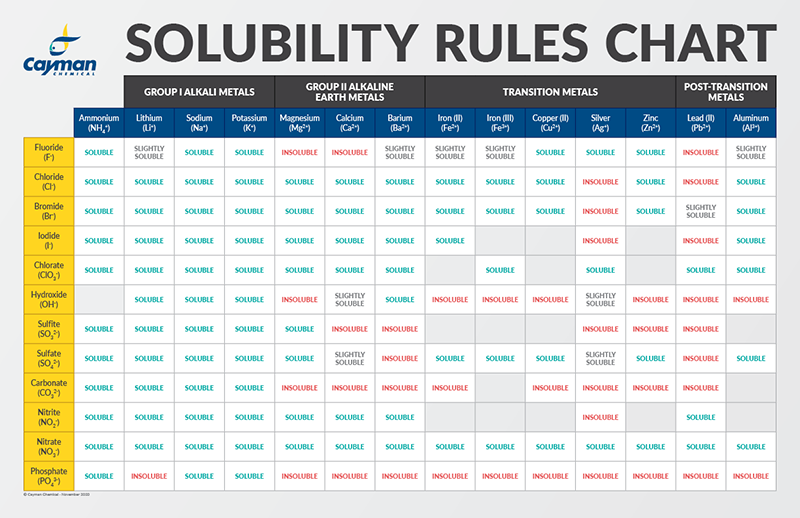
If the compound contains any of these ions, it is soluble with no exceptions. You can stop your analysis here.
List of Always-Soluble Ions
These ions form strong ion-dipole interactions with water that overpower ionic lattice energy.
| Ion | Examples |
|---|---|
| Group 1 cations | Potassium chloride, sodium carbonate |
| Ammonium | Ammonium sulfate, ammonium chloride |
| Nitrate | Magnesium nitrate, silver nitrate |
| Acetate | Sodium acetate |
| Chlorate and Perchlorate | Potassium perchlorate |
| Hydrogen carbonate | Sodium bicarbonate |
Pro Tip: If you see nitrate or ammonium present, the compound is always aqueous. This shortcut saves significant time during problem-solving.
Evaluate Halides: Chloride, Bromide, Iodide
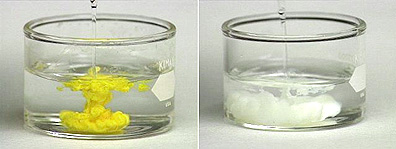
Most chloride, bromide, and iodide salts dissolve, but watch for three key exceptions.
General Rule: Soluble
Compounds like sodium chloride, potassium bromide, and calcium iodide are all soluble.
Insoluble Exceptions
A halide is insoluble if paired with silver, lead(II), or mercury(I).
Examples of insoluble halides include:
- Silver chloride forms a white precipitate
- Lead(II) bromide is insoluble
- Mercury(I) iodide is insoluble
Special Case: Fluorides
While fluorides are not always grouped with other halides, silver fluoride is insoluble even though fluoride behaves differently in some tables.
Analyze Sulfate Solubility

Sulfates are mostly soluble, but several important metals cause precipitation.
General Rule: Soluble
Sodium sulfate, potassium sulfate, and magnesium sulfate are all aqueous.
Insoluble Exceptions
Sulfate forms solids with barium, strontium, lead(II), mercury(I), and calcium.
Real-world context matters here. Barium sulfate is used in medical imaging because it is insoluble and blocks X-rays.
What About Calcium Sulfate?
Though technically slightly soluble, calcium sulfate forms a precipitate in reaction contexts. Always write it as a solid in chemical equations.
Handle Hydroxides with Care
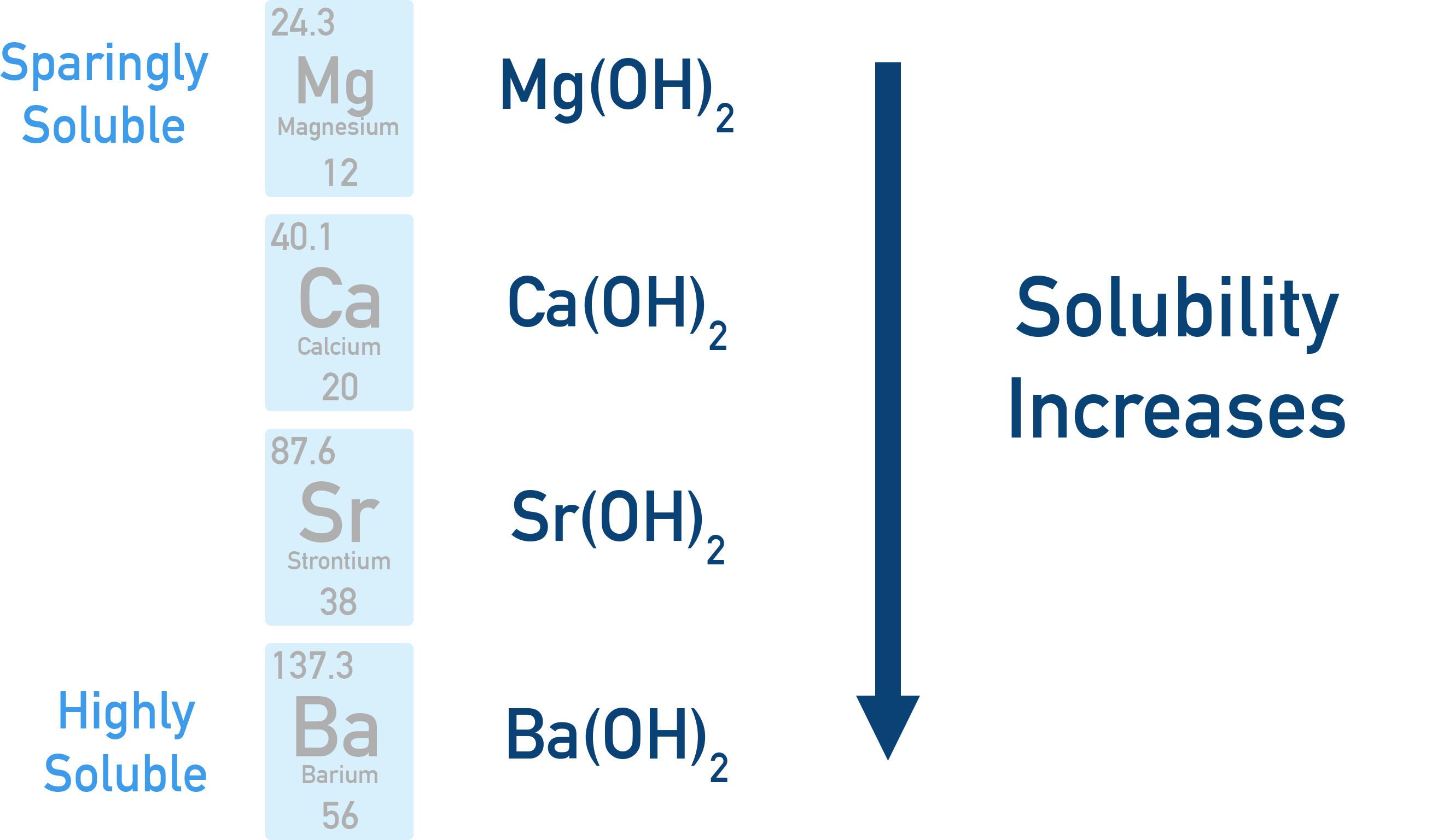
Most metal hydroxides do not dissolve except for a few key cations.
General Rule: Insoluble
Magnesium hydroxide, iron(III) hydroxide, copper(II) hydroxide, and aluminum hydroxide are all solids.
Soluble Exceptions
Hydroxides are soluble only when bonded to Group 1 metals, ammonium, or calcium, strontium, or barium.
Common Mistake: Magnesium hydroxide is insoluble. Even though magnesium is in Group 2, it is not in the exception list for hydroxides. Do not confuse it with calcium hydroxide.
Tackle Carbonates, Phosphates, and Sulfides
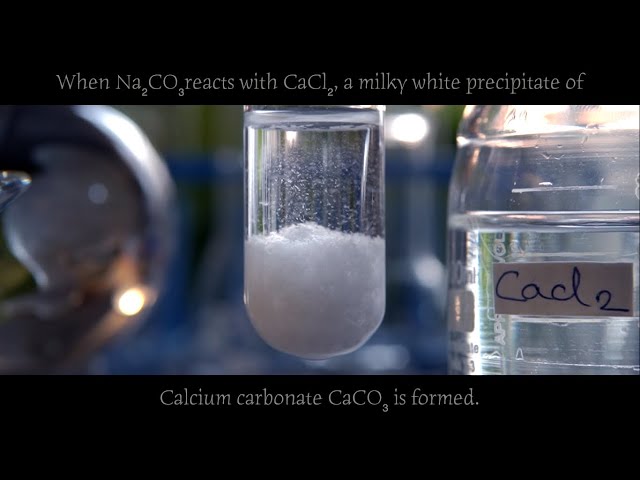
These anions typically form insoluble solids unless paired with specific cations.
General Rule: Insoluble
Compounds like calcium carbonate, iron phosphate, and copper sulfide do not dissolve.
Soluble Exceptions
They dissolve only if the cation is from Group 1 or is ammonium.
| Anion | Insoluble Example | Soluble Example |
|---|---|---|
| Carbonate | Calcium carbonate | Sodium carbonate |
| Phosphate | Aluminum phosphate | Ammonium phosphate |
| Sulfide | Lead sulfide | Lithium sulfide |
| Sulfite | Barium sulfite | Potassium sulfite |
| Chromate | Silver chromate | Sodium chromate |
Fun fact: Calcium carbonate forms limestone, stalactites, and seashells, all thanks to its insolubility in water.
Know Special Cases and Reactions
Some compounds do not just dissolve; they react with water instead.
Metal Oxides: React, Do Not Dissolve
Calcium oxide reacts with water to form calcium hydroxide. The oxide ion reacts to form hydroxide, so calcium oxide is not aqueous. It transforms into a new compound.
Ammonium Hydroxide: A Misnomer
Ammonium hydroxide does not really exist as a stable compound. It is shorthand for ammonia dissolved in water equilibrium with ammonium and hydroxide ions. It is still treated as aqueous in equations due to the presence of ammonium.
Substances Outside the Rules
Solubility tables apply only to ionic compounds. These are not evaluated:
- Diatomic gases like hydrogen and oxygen
- Water
- Metals like copper and silver
- Molecular compounds like sugar
Apply the Step-by-Step Decision Process
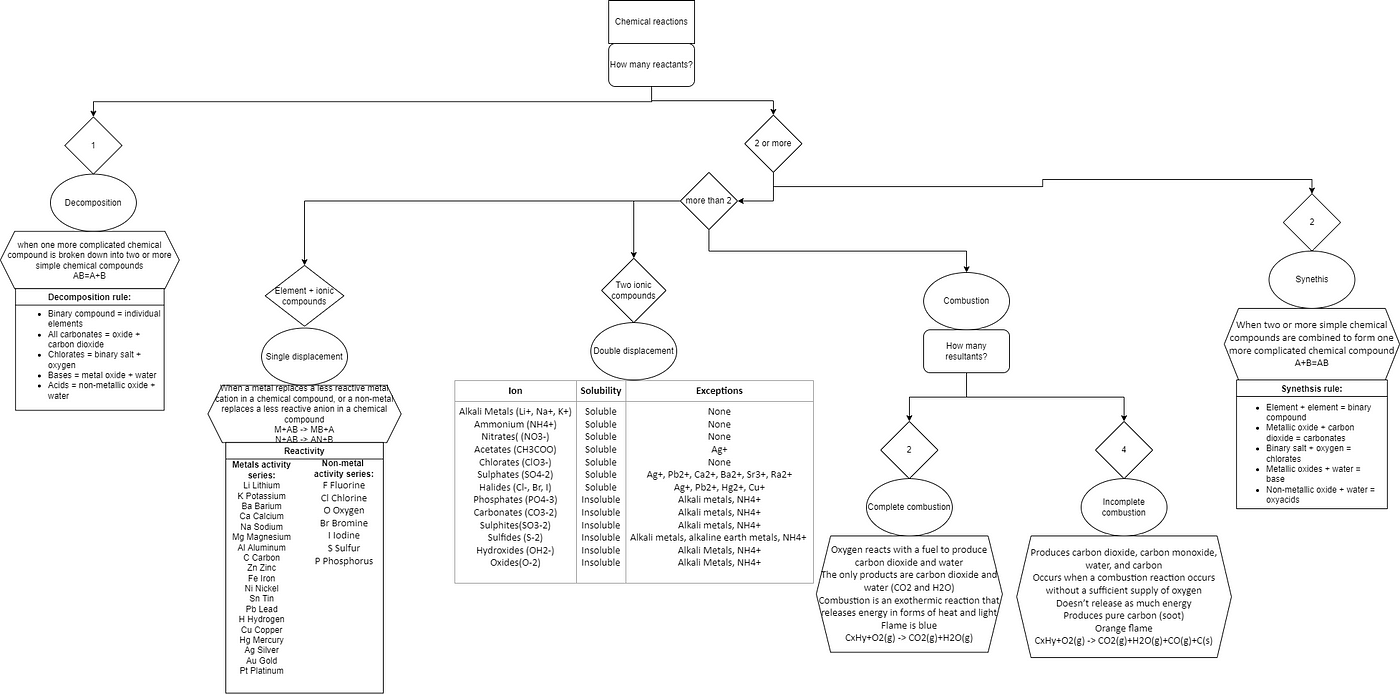
Use this foolproof method every time you need to determine solubility.
Step 1: Identify Cation and Anion
Break the formula into ions. For example, lead nitrate yields lead(II) and nitrate.
Step 2: Check for Always-Soluble Ions
Is the cation sodium, potassium, or ammonium? Is the anion nitrate? If yes, the compound is aqueous. You are done.
In lead nitrate, nitrate is present, making it soluble.
Step 3: If Not, Check Anion Category
Determine which category applies:
- Halide: Check for silver, lead(II), mercury(I)
- Sulfate: Check for barium, strontium, lead(II), calcium
- Hydroxide: Only soluble with Group 1, ammonium, calcium, strontium, barium
- Carbonate, phosphate, sulfide: Only soluble with Group 1 or ammonium
Step 4: Assign State Symbol
Soluble compounds get aqueous status. Insoluble or slightly soluble compounds get solid status. Compounds that react with water get appropriate product symbols.
Avoid Common Mistakes
Even smart students trip up here. Do not make these errors.
Confusing (s) with Soluble
The symbol (s) means solid, which is insoluble. The letter S in a table means soluble. They mean opposite things.
Treating Slightly Soluble as Aqueous
Calcium sulfate, calcium hydroxide, and silver sulfate are slightly soluble. In reaction predictions, treat them as solids because they form visible precipitates.
Misapplying Exceptions
Magnesium is not an exception for hydroxides, so magnesium hydroxide is insoluble. Calcium is an exception for hydroxides and sulfates but not for carbonates, so calcium carbonate is insoluble.
Memory Tip: Calcium gets special treatment for sulfates and hydroxides but not carbonates.
Forgetting Polyatomic Ions
Sulfate is not sulfite. Nitrate is not nitrite. Always double-check formulas.
Use Pro Tips for Speed and Accuracy
Anion-First Strategy
Always start with the anion:
- Is it nitrate, acetate, or perchlorate? It is aqueous.
- Is it chloride? Check the cation for silver, lead(II), or mercury(I).
- Is it sulfate? Check for barium, strontium, lead(II), or calcium.
- Is it hydroxide, carbonate, or phosphate? Likely solid unless the cation is Group 1 or ammonium.
This approach cuts decision time in half.
Flashcard Priority List
Memorize these key groups:
- Always soluble: Group 1, ammonium, nitrate, acetate
- Halide exceptions: silver, lead(II), mercury(I)
- Sulfate exceptions: barium, strontium, lead(II), calcium
- Hydroxide exceptions: Group 1, ammonium, calcium, strontium, barium
These cover 95% of cases you will encounter.
Bracket Method for Equations
When writing a reaction, write the full formula, draw a bracket around it, and write the state symbol immediately above. This prevents errors in net ionic equations later.
Master Net Ionic Equations
Solubility knowledge shines when writing net ionic equations.
Step 1: Write Complete Ionic Equation
Break all aqueous compounds into ions. Keep solids, liquids, and gases intact.
For silver nitrate plus sodium chloride: silver plus nitrate plus sodium plus chloride yields silver chloride plus sodium plus nitrate.
Step 2: Cancel Spectator Ions
Spectator ions appear unchanged on both sides. Sodium and nitrate are spectators in this reaction.
Step 3: Write Net Ionic Equation
The net ionic equation shows the actual chemical change: silver ion plus chloride ion yields silver chloride.
Key Takeaways for Using Solubility Tables
Knowing how to use a solubility table is not about rote memorization. It is about applying a clear, logical system that works every time. Start by identifying the cation and anion, then check for always-soluble ions like nitrate and ammonium. Next, determine the anion category and hunt for specific exceptions. Finally, assign the correct state symbol with confidence.
Avoid the common traps. Do not confuse the symbol (s) with soluble. Treat slightly soluble compounds as solids. Never assume one exception applies to all anions. Remember that calcium is special: it gets exceptions for sulfates and hydroxides but not for carbonates.
With practice, you will predict precipitates in seconds, write perfect net ionic equations, and master reaction chemistry. Keep a solubility chart handy, use flashcards for the exceptions, and drill real examples. Soon, this skill will be second nature.
Frequently Asked Questions About Solubility Tables
How do I read a solubility table?
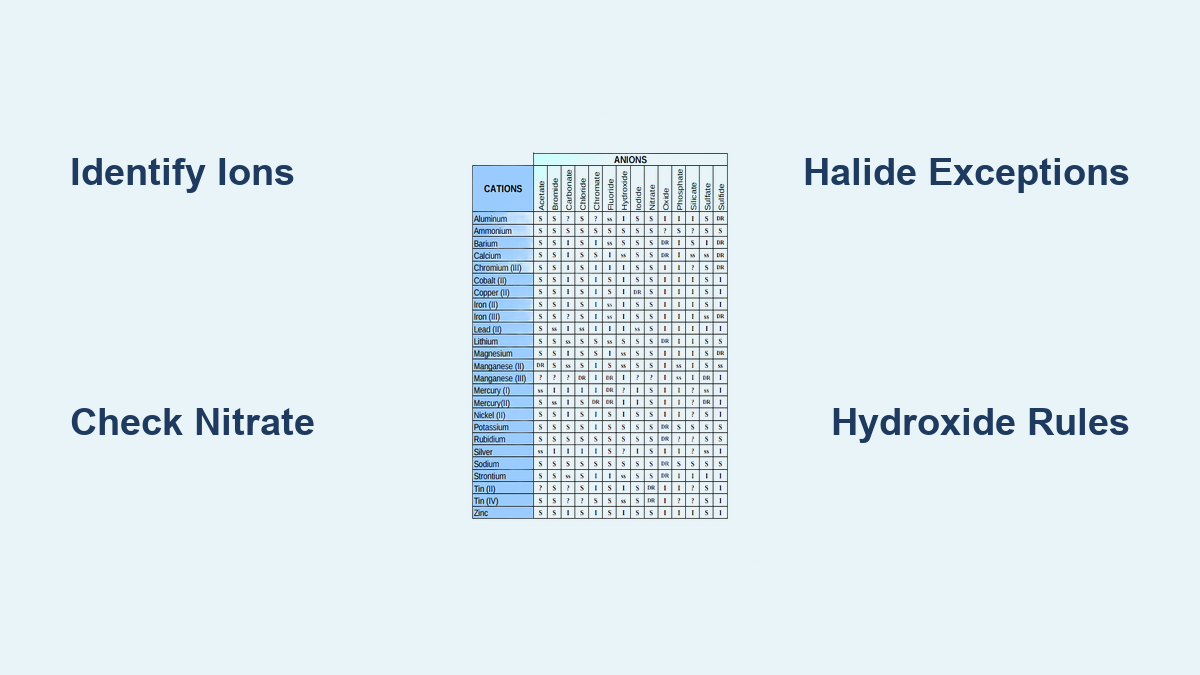
Locate the anion in the top row and the cation in the left column. Find where they intersect to see if the compound is soluble (S), insoluble (I), slightly soluble (SS), or reacts (R).
What does (s) mean in chemistry?
The symbol (s) means solid, indicating the compound is insoluble and will form a precipitate. This is the opposite of the letter S in solubility tables.
Are all Group 1 compounds soluble?
Yes. All compounds containing Group 1 metals (lithium, sodium, potassium, rubidium, cesium) are soluble in water with no exceptions.
What is the difference between soluble and slightly soluble?
Soluble compounds dissolve completely in water. Slightly soluble compounds dissolve only minimally but enough to sometimes produce weak precipitates. For reaction predictions, treat slightly soluble compounds as solids.
Why is calcium carbonate insoluble if calcium is an exception for some anions?
Calcium is an exception only for sulfates and hydroxides. For carbonates and phosphates, calcium is not an exception, so calcium carbonate is insoluble.
How do I predict if a precipitate will form in a reaction?
Identify all possible products, determine their solubility using the rules, and check if any product is insoluble. If so, a precipitate forms.