How to Play Table Shuffleboard
You’re at a bar or game room, eyeing that long, sleek table with pucks scattered at one end. It’s table shuffleboard, a game of precision, strategy, and subtle mind games. Whether you’re a beginner or just brushing up, learning how to play table shuffleboard opens the door to a surprisingly deep and competitive pastime. The goal is simple: slide your pucks farther than your opponent’s and into high-scoring zones. But mastering it requires skill, control, and a bit of cunning.
In this guide, you’ll learn everything from setup and rules to scoring and advanced tactics. You’ll discover how to avoid fouls, exploit table drift, and even use psychological tricks like the pros. Whether you’re playing casually or aiming for tournament-level precision, this breakdown covers all the essentials.
Setting Up Your Game: Players and Formats
Before the first puck slides, you need to know who plays and how teams work.
Singles vs. Doubles Format
In singles, two players face off with one red set and one blue set of four pucks each. Both players start at the same end and alternate shots down the table.
In doubles, four players pair up with teammates standing on opposite ends. After one team finishes shooting from one end, the other team shoots from the far end. This dual-direction format means two games happen simultaneously, and scores are combined.
Casual games may allow all players to stand at one end with teammates alternating turns. Tournament rules enforce the opposite-end setup for fairness and proper game flow.
Determining Who Shoots First
The starting player is chosen by coin toss, mutual agreement, or by winning the previous round. The winner shoots first and typically maintains the advantage of going first in subsequent rounds if they score.
Players alternate turns, one puck at a time, until all eight pucks are in play. No re-shots are allowed, even if a puck falls short or flies into the gutter.
Understanding Your Equipment: The Table and Pucks

Knowing your battlefield gives you a strategic edge. The table isn’t just a flat surface; it has quirks, zones, and hidden challenges.
Table Dimensions and Surface
Table shuffleboard tables range from 9 to 22 feet long and are at least 20 inches wide. Longer tables require faster wax and greater precision.
The playing surface is coated with silicone beads, commonly called shuffleboard wax, sand, or cheese, to reduce friction and allow smooth puck glides. Different wax speeds suit different table lengths and skill levels.
No table is perfectly flat. Most have slight curves called drifts that can push pucks left or right. Pros learn to read these imperfections and adjust their shots accordingly.
Pucks and Color Coding
Each player uses four pucks made of metal with a plastic coating. Standard colors are red and blue, distinguishing each player or team.
Pucks must be slid by hand with no cues or sticks allowed. A clean release before crossing the foul line is crucial.
Foul Lines and What Makes a Legal Shot
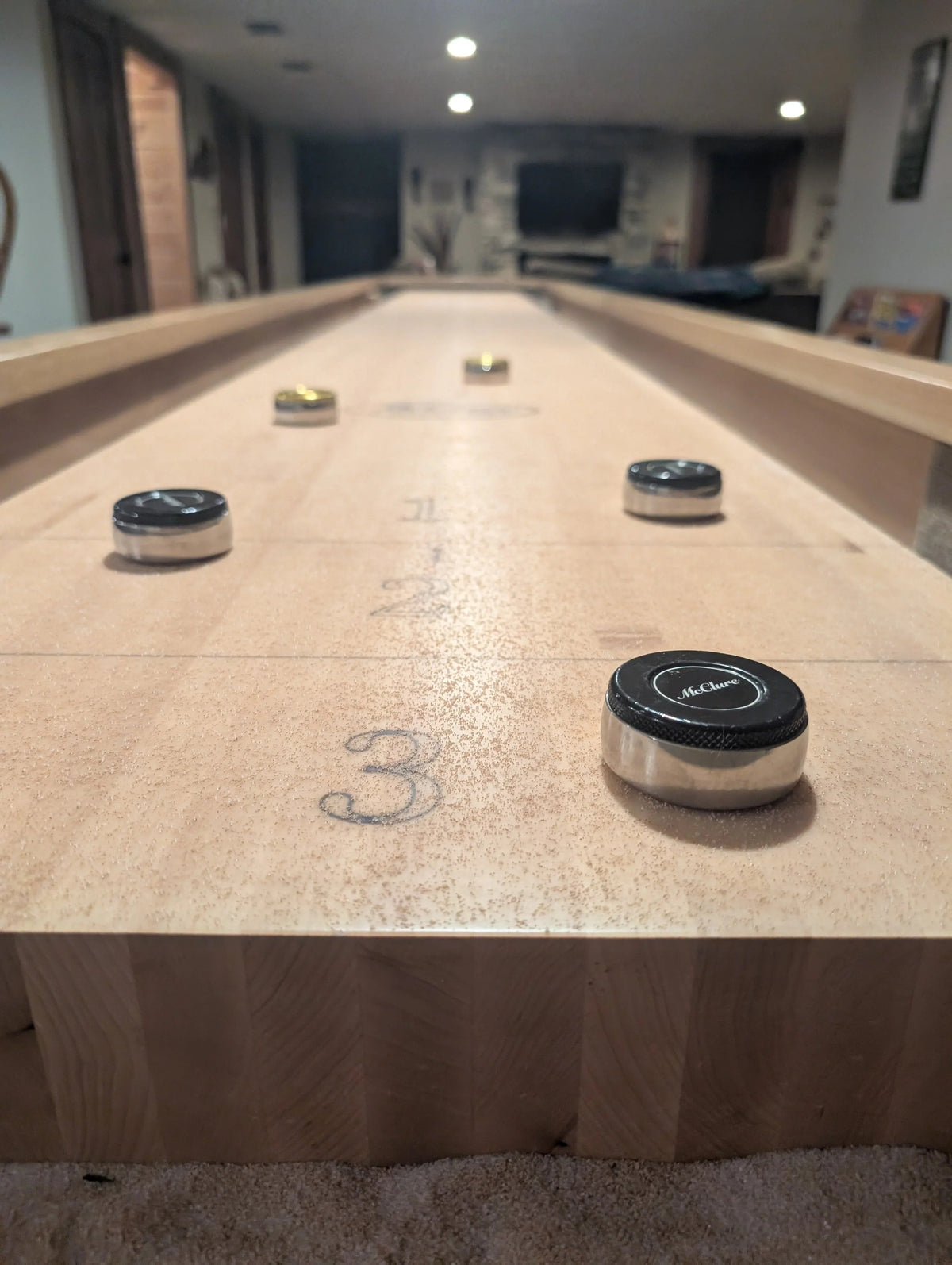
Two foul lines define what counts as a valid shot. Mess up here, and your puck is dead.
The Near Foul Line: No Crossing Allowed
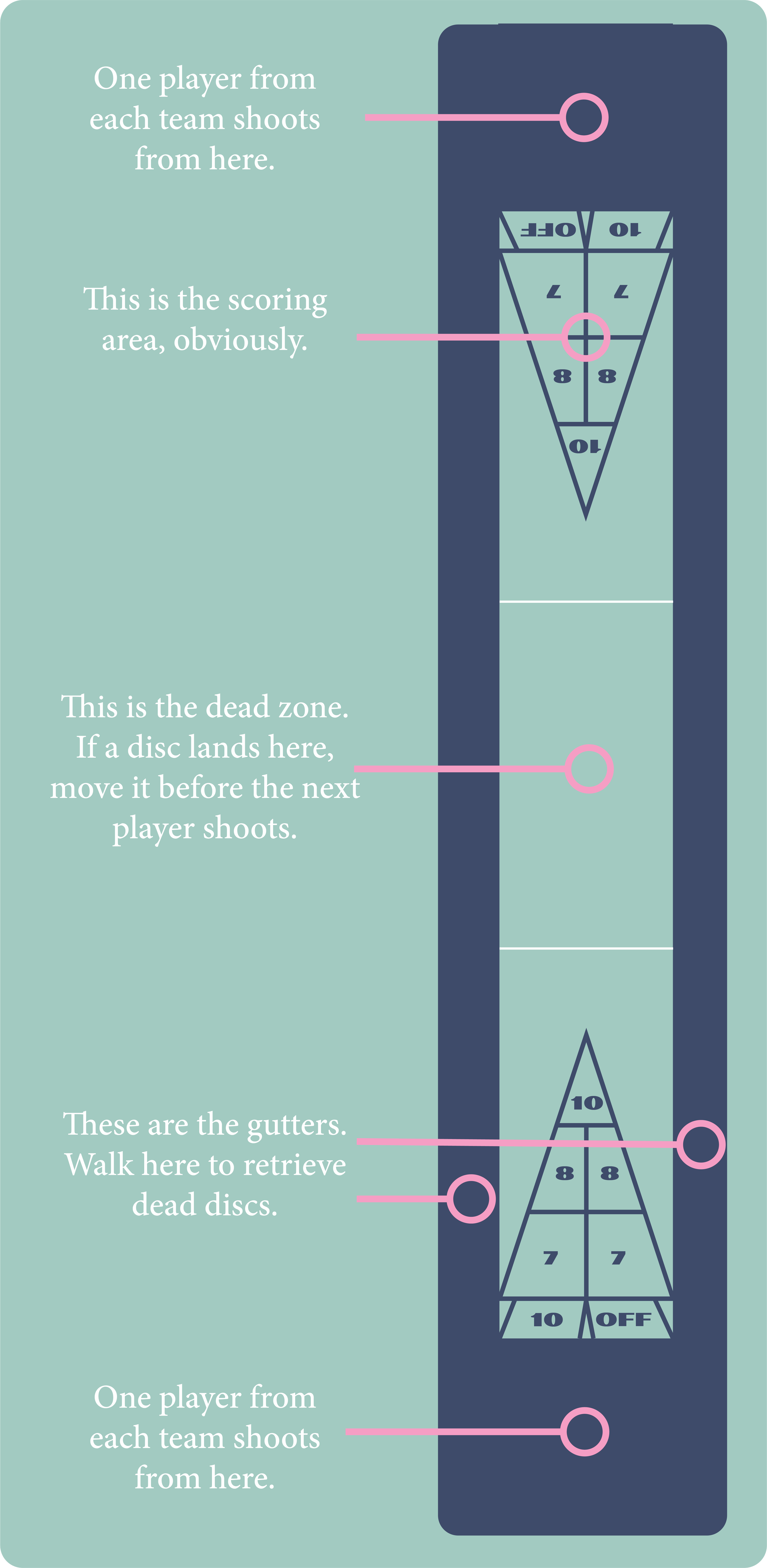
Located 6 feet from the end of the table, this line marks your shooting boundary. You must release the puck before your hand crosses it.
If you cross the line during release, it’s a foul shot. The puck is immediately removed from play with no exceptions.
Stay low, keep your hand behind the line, and use a smooth wrist motion for control.
The Far Foul Line: Must Cross to Score
At the start of the scoring zone, this line separates the center third from the 1-point area. Any puck that stops before crossing it is invalid and removed.
There’s a critical nuance: if your puck crosses the line, hits an opponent’s puck, and bounces back into the non-scoring zone, both pucks are removed. This rule prevents lucky rebounds from counting.
Only pucks fully beyond the far foul line stay in play.
Scoring Zones and Point Values
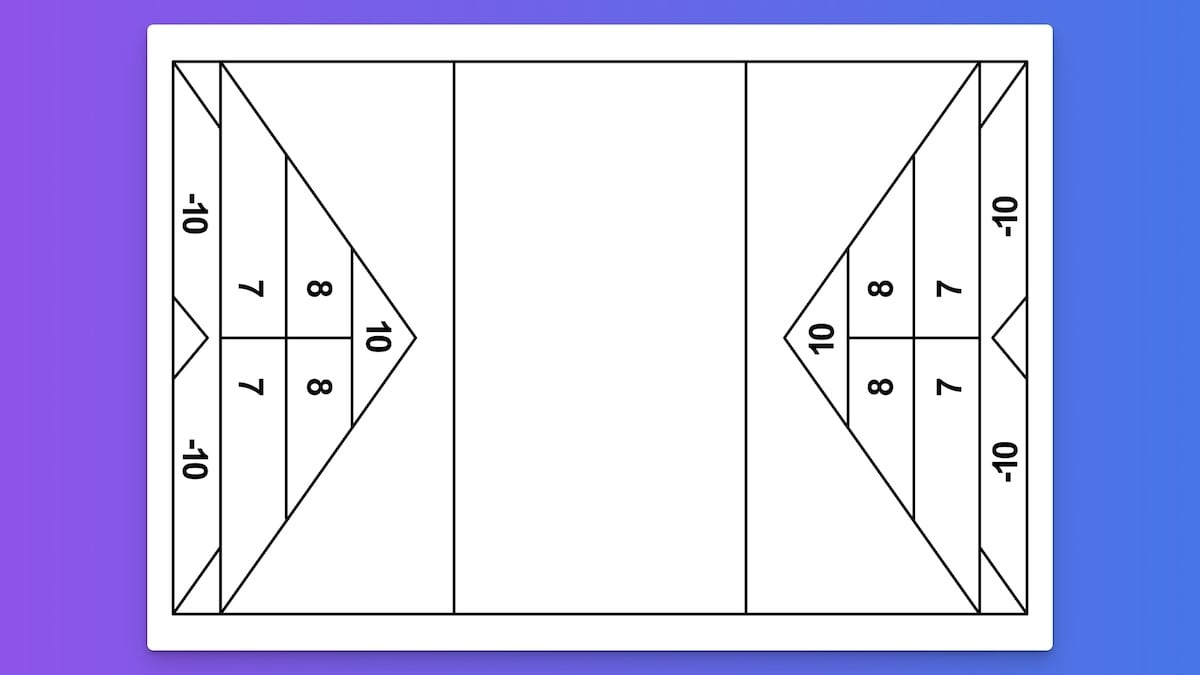
Scoring isn’t just about hitting the right zone; it’s about outlasting your opponent’s best puck.
Zone Breakdown: 1, 2, 3, and the Hanger
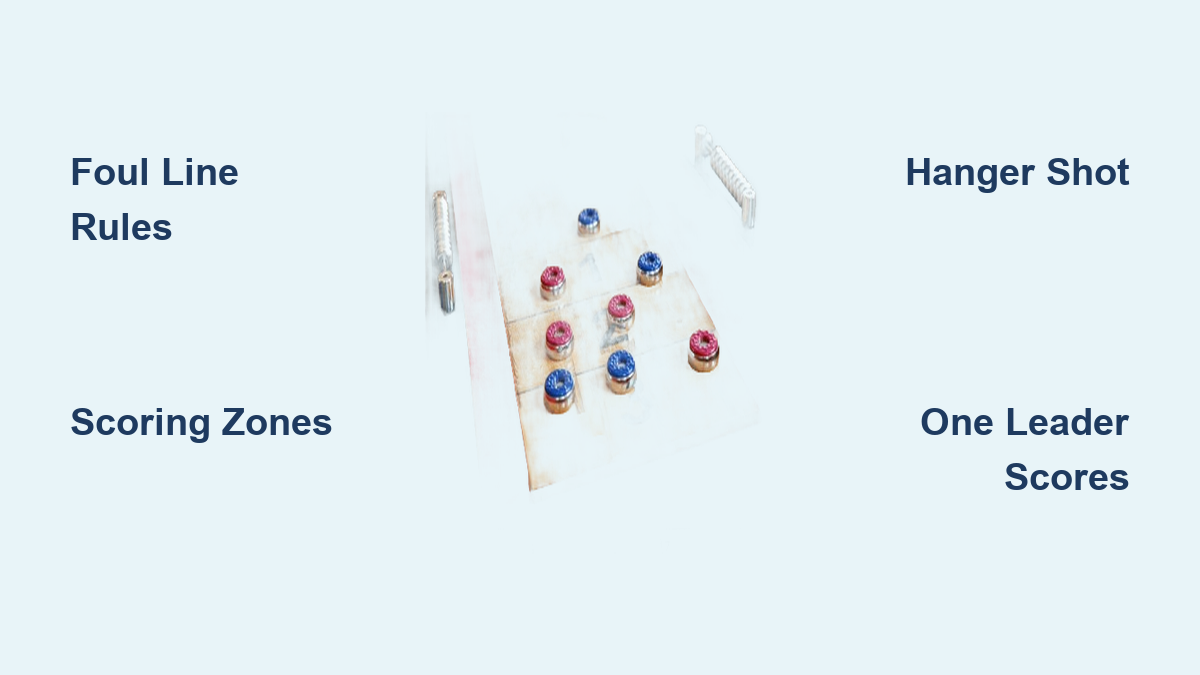
The end of the table has three main zones. Zone 1 is closest to the foul line and scores 1 point. Zone 2 is the middle section and scores 2 points. Zone 3 is the outer edge and scores 3 points.
The hanger scores 4 points. This occurs when a puck is partially hanging off the end of the table. It’s the highest-value shot, but risky: too far, and it drops into the alley.
Line Rules: On the Line Means Lower Score
A puck must be completely past the line to count for the higher zone. If it’s touching or straddling the line, it scores the lower value.
For example, a puck resting on the line between Zone 2 and Zone 3 earns only 2 points, not 3. This rule applies to all lines, including the far foul line.
Gutter and Alley: Zero Points
The gutter runs along the sides and end of the table. Any puck that falls in is out of play and scores zero points.
Knocking an opponent into the gutter is a valid defensive tactic, but be careful not to follow them in.
How Scoring Actually Works
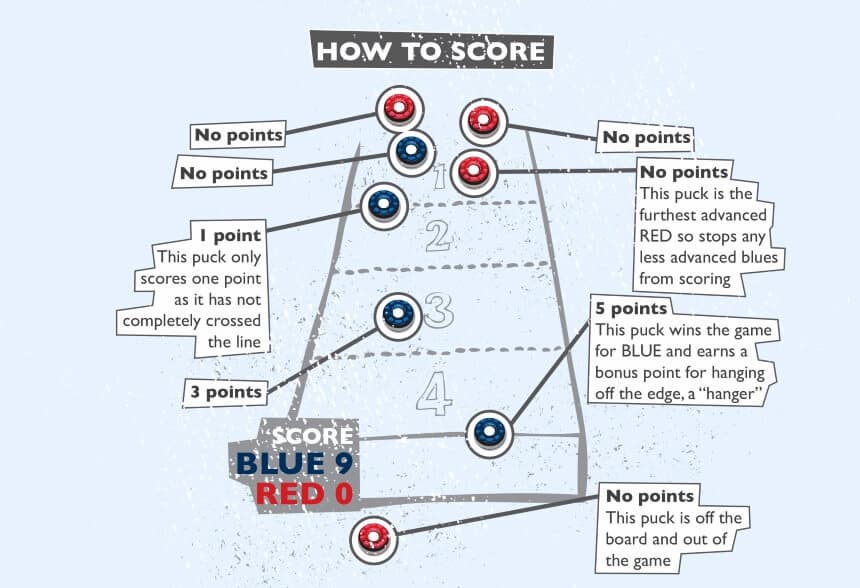
Here’s the core twist in table shuffleboard: only one player or team scores per round.
Step-by-Step Scoring Process
All pucks are played, eight total with four per player or team. First, identify the leader by finding the puck closest to the far edge. Whoever owns that puck is the round’s leader. Next, count qualifying pucks. The leader scores for every one of their pucks that is farther down than the opponent’s furthest puck. The opponent scores zero, even if they have pucks in high zones.
Scoring Example
Red has one puck in Zone 3, one in Zone 1 ahead of Blue, and two in the back. Blue has one puck in Zone 1, but it’s behind Red’s 3-pointer.
Red is the leader. Red scores 3 points for the front puck plus 1 point for the second puck ahead of Blue, totaling 4 points. Blue scores zero.
If both players have pucks tied for position, house rules vary, but typically the next closest puck breaks the tie.
Popular Game Formats and Winning Conditions
Different formats change the pace, strategy, and target score.
Standard Knock-Off: First to 15 or 21
This is the most common format. In singles, first to 15 points wins. In doubles, first to 21 points wins.
Players alternate shots, aiming to score while knocking opponents off. The game is defensive, so blocking and protection are key.
Some rule sets require a two-point lead. If the score reaches 15-15, play continues until one player leads by two.
Crazy Eight: Do Not Bust
Played to exactly 8 points. If a player goes over, their score resets to zero.
This forces precision. A single aggressive shot can wipe out progress, so every move counts.
Horse Collar: High-Stakes Challenge
Aimed at 51 points, this version often includes betting. Some rules say a hanger wins the game outright. Certain shots can be worth up to 26 points in gambling contexts.
Popular among hustlers and gamblers, it’s less about pure skill and more about nerve.
Tap and Draw: First-Shot Advantage
Unlike standard play, players can tap their own puck with another to push it farther. This gives the first shooter a big edge because they can set up and improve their position before the opponent shoots.
Target Shuffleboard: Aim for Accuracy
Like darts, players aim for specific targets worth 1 to 4 points. Only the round winner scores.
This emphasizes smart shot selection over brute knock-off tactics.
Dutch Sjoelen: A Unique Variant
This variant, popular in the Netherlands, plays differently from standard American shuffleboard.
Sjoelbak Layout and Scoring
The board is 2 meters long and 40 centimeters wide with four scoring boxes valued 2, 3, 4, and 1 points. Players use 30 wooden pucks each and have three sub-turns to slide pucks into the boxes.
For every complete set, meaning one puck in each box, the total of 10 points is doubled to 20 points. If you get seven full sets, that’s 140 points. Remaining pucks add their face value.
The maximum possible score is 148 points. If achieved in fewer than three turns, unused pucks are returned, maxing out at 156 points.
This variant is governed by the Algemene Nederlandse Sjoelbond, and a World Cup has been held since 2008.
Strategy: Offense, Defense, and Mind Games
Winning isn’t just about sliding pucks; it’s about outthinking your opponent.
Offensive Tactics
Aiming for the hanger provides a 4-point shot that can swing a round, but only attempt it when the board is clear. Knock-offs are deliberate strikes to remove opponent pucks or drop them into lower zones. Blocking involves placing a puck just behind an opponent’s high-value piece to prevent them from knocking it off. Protection uses a second puck to shield your leader from being hit.
Defensive Play
Outdistancing the opponent means even a 2-point puck scores zero if your furthest puck is ahead. Control over power is essential; gentle, precise slides beat wild throws. Overpowering leads to gutters.
Read the board and learn its drift. If it curves right, aim slightly left. Pros adapt to curves up to 5 or 6 inches.
Psychological Warfare
Legend has it that Billy Mays, one of the greatest hustlers known as Texas Billy, used mind games to win. He would act clumsy to lure opponents into betting. He used trash talk to distract or intimidate. He performed trick shots to shake confidence. He offered handicaps like playing one-handed or blindfolded, then dominated.
Knowing a specific table gives a 72% win rate advantage according to pros. Home-field knowledge is real.
Rules and Etiquette: Play Fair, Win Respect
Respect the game and your opponent, especially in competitive settings.
Key Etiquette Rules
Shake hands before and after the game. Stay still and silent during the opponent’s shot. Don’t touch the table or pucks in play. In doubles, don’t walk to the other end; ask your partner for puck positions instead.
Common Violations and Penalties
Foul line crossing results in puck removal. Short shots that don’t cross the far foul line are removed. Vibration causing table shake may cost a point. Holding a puck during the opponent’s turn is a violation. Rubbing hands on the surface is prohibited because it can alter wax distribution.
Penalties vary. Tournament play is strict, while casual games are more forgiving.
Winning the Game: Final Score and Match Flow
A match ends when a player or team hits the target score.
Standard Winning Scores
Singles win at 15 points. Doubles win at 21 points. Horse Collar wins at 51 points.
The winner of each round typically shoots first in the next, giving a psychological and strategic edge.
In league play, matches may be best-of-three or best-of-five frames, but most games continue until the point goal is reached.
Pro Tips for Beginners
Start strong with these actionable tips. Practice control using a light touch and focus on placement, not power. Aim for Zone 2 first because it’s safer than chasing Zone 3. Watch the drift to see how pucks naturally curve, then adjust your aim. Clear the alley by waiting until the round ends to retrieve pucks. Learn from losses because even pros drop pucks into the gutter.
Frequently Asked Questions About How to Play Table Shuffleboard
What is the objective of table shuffleboard?
The objective is to slide your four pucks farther down the table than your opponent’s and into high-scoring zones. To score points, your puck must be further than the opponent’s furthest puck.
How many points do you need to win a game?
In singles, first to 15 points wins. In doubles, first to 21 points wins. Some formats like Crazy Eight require exactly 8 points.
What happens if a puck goes into the gutter?
Any puck falling into the gutter scores zero points and is removed from play for that round. Knocking an opponent’s puck into the gutter is a valid defensive move.
Can you tap your own puck to move it farther?
In standard play, no. However, in a variant called Tap and Draw, players can tap their own puck with another to push it farther. This gives the first shooter a significant advantage.
What is a hanger in shuffleboard?
A hanger is a puck hanging partially over the edge of the table. It scores 4 points, the highest possible score for a single puck.
How do foul lines work in table shuffleboard?
The near foul line is 6 feet from the end. You must release the puck before your hand crosses it, or the puck is removed. The far foul line marks the beginning of scoring zones; pucks not crossing this line score zero.
Key Takeaways for Playing Table Shuffleboard
Table shuffleboard is more than a bar game. It’s a blend of physics, psychology, and precision. From the silicone-dusted surface to the thrill of a perfect hanger, every shot matters. Remember the core scoring rule: only the leader scores, so positioning beats raw power. Master the foul lines, respect the gutter, and always watch for table drift. Whether you’re playing casually or diving into tournament rules, you now know how to set up, score, and strategize like a pro. Grab your pucks, respect the foul lines, and slide your way to victory.