How to Choose a Foosball Table: Quick Guide
You have decided to bring the excitement of a game room into your home. But walking through the options, you quickly realize that choosing a foosball table is not as simple as it seems. Prices range from under $100 to over $4,000, and the differences between models are not always obvious. The wrong choice can lead to a wobbly playing surface, frustrating rod action, or a table that simply does not fit your space. This guide breaks down exactly how to choose a foosball table that matches your skill level, space, and budget, so you can enjoy years of smooth, stable play.
This article covers everything from understanding player needs and measuring your room to evaluating construction quality and comparing brands. By the end, you will know exactly what features matter, what to avoid, and how to find a table that delivers lasting value.
Match Your Table to Your Players
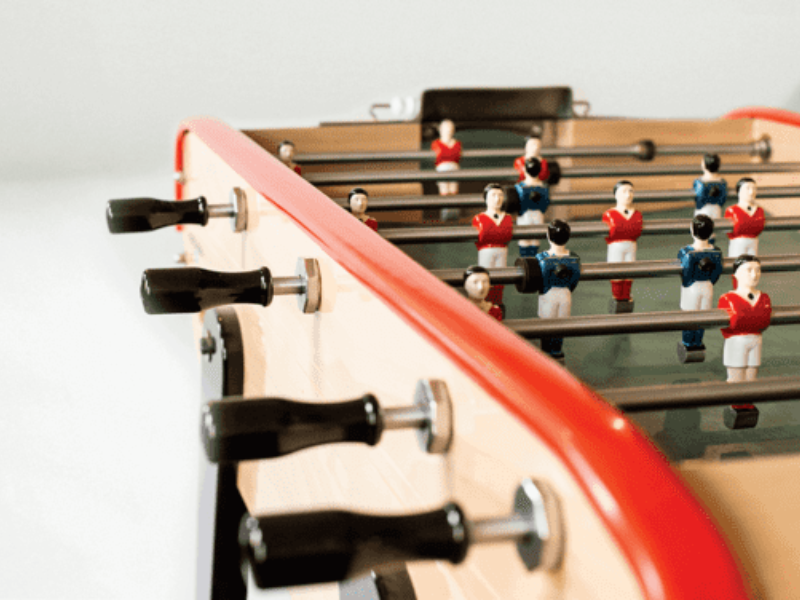
The first step in choosing a foosball table is not about features. It is about who will use it most.
Family or Casual Players
If you want a table for kids, weekend parties, or occasional games, prioritize safety and stability. Look for models with rounded corners, non-slip feet, and handles that fit various hand sizes. Mid-range standalone tables in the $300 to $800 range offer the best balance. They are built to handle regular use without the premium cost of tournament-grade models.
Avoid lightweight tabletop versions. They wobble during play and wear out quickly. Choose a full-sized cabinet table weighing at least 150 pounds to prevent shifting when players swing the rods aggressively.
Serious or Competitive Players
If you play frequently or want to develop advanced skills, look for regulation-size tables with counterbalanced player figures, solid or high-gauge hollow rods, and smooth bearings. These features enable advanced techniques like snake shots and pull shots.
Tornado and Bonzini models deliver unmatched precision and speed. They weigh 200 pounds or more, feature reinforced frames, and often include selectable goalie setups. While pricier, they provide a true competitive experience.
Commercial or High-Traffic Use
Bars, arcades, or office lounges need commercial-grade durability. These tables often exceed 300 pounds and include steel-reinforced cabinets, coin-operation systems, and lockable storage. They use stainless steel rods, industrial bearings, and spill-resistant surfaces. While they cost $2,000 or more, their lifespan justifies the investment in busy environments.
For Kids or Small Spaces
In apartments, dorms, or homes with young children, size and safety come first. Choose a tabletop or compact model with telescopic rods. These retract instead of sticking out the other side, eliminating injury risks. Look for lightweight, portable designs that fold or store easily. While play quality will not match full-sized tables, they offer fun without taking up permanent space.
Measure Space Before You Buy
A great table is useless if it does not fit in your room or cannot be delivered through your door.
Room Clearance Requirements
A standard foosball table is 55 to 58 inches long and 29 to 32 inches wide. But you need space around it to play comfortably.
Allow 3 to 4 feet on both long sides so players can move and swing rods freely. Leave 18 to 24 inches at the ends for ball retrieval and scorekeeping. Measure your room with tape on the floor to visualize the full footprint. A table that fits technically but leaves no room to play defeats the purpose.
Entry and Delivery Challenges
Many buyers forget that the table must fit through doorways, hallways, and stairwells, not just in the room. Check the packaged dimensions, not just the assembled size. Some tables come in multiple boxes. Others arrive fully assembled and massive. If the table needs to go upstairs or through a narrow entry, white-glove delivery is worth the extra cost.
Avoid models that do not fold unless you are certain about access. Measure twice, buy once.
Indoor vs. Outdoor Placement
Most foosball tables are indoor-only. Exposing them to sun, rain, or humidity causes warping, rust, and peeling. If you want an outdoor table, choose one built with marine-grade plywood, UV-resistant laminate, stainless steel or powder-coated hardware, and telescopic rods. Even outdoor models should be covered when not in use to prevent fading and moisture buildup.
For damp basements or garages, avoid particle board cabinets. Opt for sealed MDF or solid wood with climate control to prevent swelling.
Set a Realistic Budget
Foosball tables range from $100 to $4,000 or more. Your budget should reflect how much you will use the table and for how long.
Entry-Level Tables
These are often tabletop or compact models made of plastic or particle board. They are fine for testing interest or for young kids, but do not expect durability. The pros include being cheap, portable, and easy to store. The cons include being wobbly, having poor rod action, and having a short lifespan.
Avoid standalone tables under 75 pounds. They are usually low-quality and shift during play.
Mid-Range Tables
This is the sweet spot for most families. You get solid MDF or composite cabinets, smooth hollow steel rods, nylon bearings for quiet fast play, and better aesthetics and stability. Models like the Kick Legend or Warrior Professional offer excellent value here, with strong support and replaceable parts.
Premium Home Tables
Built for serious players who host often, these tables feature heavy-duty bracing at 200 pounds or more, counterbalanced players, pro-level bearings, and high-end finishes. The Tornado Elite and Bonzini B90 shine here, offering near-tournament performance with home-friendly looks.
Commercial and Tournament Tables
These are built to last decades. Used in professional leagues, they feature stainless steel or split cabinets, heavy-gauge hollow rods, patent-protected bearing systems, and selectable goalie setups. While expensive, their total cost of ownership is low thanks to durability and parts availability.
Compare Cabinet and Build Quality

The cabinet is the backbone of the table. Its material determines stability, feel, and longevity.
Solid Wood vs. MDF vs. Particle Board
Solid wood (maple, oak, walnut) looks luxurious and resists vibration but can warp in humidity. High-grade MDF is stable, affordable, and widely used in quality tables. Avoid particle board. It swells with moisture and feels flimsy.
A heavier table does not move during aggressive play. Use this guide. Tables under 100 pounds are unstable and should be avoided. Tables at 150 to 250 pounds are ideal for home use. Tables at 200 to 350 pounds or more offer commercial-grade stability. If the table shakes when you spin the rods, it is too light.
Choose the Right Rods and Bearings

Rods and bearings control speed, control, and durability.
Solid vs. Hollow vs. Telescopic Rods
Solid steel rods are durable, precise, and heavier. They are best for professionals. Hollow steel rods are lighter and faster, common in home tables. High-gauge options (0.156 inch) resist bending. Telescopic rods retract into the table and are essential for child safety and outdoor storage. Chrome-plated rods resist rust and glide smoothly.
Bearing Types Matter
Nylon bearings are quiet, low-maintenance, and common in home tables. Metal bearings are built for heavy use and found in commercial models. Split bearings allow fine-tuning and smoother action.
Bearings should be cleanable and replaceable. If they grind or stick, gameplay suffers.
Pick Your Gameplay Style

Foosball is not one-size-fits-all. The two main styles offer very different experiences.
American-Style Play
This style focuses on speed and power. The player feet are wide for strong shots. The ball type is smooth plastic. The goalies usually use a 3-goalie setup. The surface is fast laminate or glass. This style is best for beginners, fast-paced fun, and bars.
European-Style Play
This style focuses on control and strategy. The player feet are narrow for trapping and finesse. The ball type is cork, which is softer and offers more grip. The goalies use a single goalie. The surface is wood or specialty like Gerlex Lenolium. This style is best for skilled players and tactical play.
Many modern tables let you switch between 1-goalie and 3-goalie setups, giving you both styles in one table.
Know the Different Table Types
Not all foosball tables are full-size standalone units. Choose based on your needs.
Standalone or Home Tables
These offer the most authentic feel, durability, and stability. They need dedicated space. They are best for game rooms and serious players.
Tabletop or Mini Tables
These are portable, cheap, and fit anywhere. They tend to be wobbly with a small field and short lifespan. They are best for kids and temporary use.
Multi-Game Combo Tables
These save space and add variety with air hockey, ping pong, or other games. The foosball play is often subpar. They are best for families with limited space.
Furniture-Style Tables
These double as dining or coffee tables. The foosball quality is secondary to design. They are best for living rooms without game rooms.
Outdoor Tables
These are weather-resistant with telescopic rods. They tend to be lighter and less premium. They are best for patios and pool houses.
Check for Essential Features
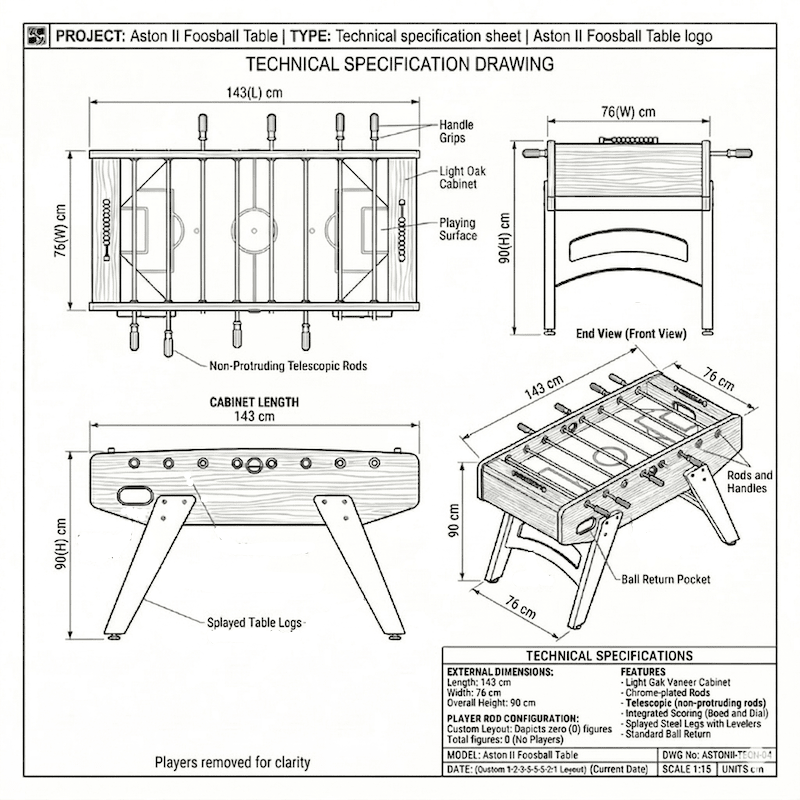
Do not overlook these must-have features. They make or break the experience.
Adjustable Leg Levelers
Floors are not perfectly flat. Without threaded levelers, the ball rolls to one side. Ensure levelers can adjust at least 1 inch and lock in place. Test by rolling a ball on a still table. If it drifts, the table is not level.
Ball Return System
Side return is traditional, with the ball exiting to the side. Central return brings the ball back to the center and keeps the game flowing faster. Ensure the channel is smooth and jam-free.
Corner Kick-Out Rails
Sloped edges at the corners prevent balls from getting stuck. Without them, play stops too often.
Scoring Options
Manual bead scorer is classic, reliable, and requires no batteries. Electronic scorer is flashy and includes timer and sound. Manual is more durable. Electronic is fun but can fail.
Safety Add-Ons
Rod guards prevent fingers from getting pinched and are critical for kids. Rounded corners reduce injury risk. Non-slip feet keep the table from sliding.
Evaluate Warranty and Support
A great table is only as good as the parts behind it.
Why Support Matters
Even the best tables need occasional repairs. Can you get replacement players, bearings, or rods five years later? Brands like Kick offer lifetime parts coverage, a huge advantage. Others may go out of business or stop making parts.
What to Look For
Look for a warranty length of at least 1 year on parts. Some offer longer (5 to 10 years) on cabinets. Check if there is a real support team and whether they are responsive. Verify that parts are listed and in stock on the brand website.
A slightly more expensive table with strong support will outlast a cheap one that becomes junk when a bearing fails.
New vs. Used: Which Is Better?
Buying New
The pros include full warranty, all parts included, and reliable condition. The cons include higher upfront cost. Buying new is best for most buyers, especially first-time owners.
Buying Used
The pros include getting high-end tables at lower prices. The cons include risk of damage, missing parts, and no warranty.
If buying used, inspect the rods for straightness by holding them up to light. Check the playfield for warping or deep scratches. Test the bearings for smooth rotation. Look at the cabinet for cracks or water damage. Avoid tables with bent rods or wobbly legs. They are not worth fixing.
Plan Delivery and Assembly
Even the best table is a headache if you cannot get it inside.
Delivery Options
Curbside delivery is cheapest. You move it in yourself, which is risky for heavy tables. White-glove delivery is worth it for tables over 200 pounds. The team brings it inside, sets it up, and removes packaging. If the table is going upstairs, white-glove is strongly recommended.
Assembly Time
Expect 1 to 3 hours with two people. Most kits include tools, but have a level, screwdriver, and rubber mallet ready. Check if professional assembly is offered. Some retailers provide it for a fee.
Maintain for Longevity
A well-maintained table can last decades.
Weekly Care
Wipe the playfield with a soft, slightly damp cloth. Dust rods and goals. Check for loose bolts.
Monthly Maintenance
Apply foosball-safe silicone oil to rods. Never use WD-40. It attracts dust and gums up bearings.
Long-Term Protection
Use a cover when not in use. Keep out of direct sunlight to prevent fading. Store extra balls, handles, and players. Replace worn parts early. Do not wait for failure.
Avoid These Common Mistakes
Buying too light a table causes shifting during play. Ignoring clearance leaves no space to swing rods. Choosing price over quality leads to fast breakage. Skipping telescopic rods for kids creates a safety hazard. Overlooking support means no repairs when parts fail. Picking style over function means the table does not play well. Using an indoor table outdoors leads to warping, rust, and early death.
Key Takeaways for Choosing Your Foosball Table
Choosing the right foosball table comes down to three things. First, know who will play and match the table to their skill level and safety needs. Second, measure your space carefully, including doorways and clearance around the table. Third, prioritize weight, build quality, and brand support over flashy looks. Whether you go for the speed of an American-style table or the finesse of a European-style model, the best table is one that fits your life and keeps the game going for years to come.
Frequently Asked Questions About Choosing a Foosball Table
What is the best foosball table for a family?
The best foosball table for a family is a mid-range standalone model in the $300 to $800 range. Look for safety features like rounded corners, non-slip feet, and rod guards if you have children. Tables like the Kick Legend or Warrior Professional offer excellent value with durable construction and strong parts support.
How much should I spend on a good foosball table?
You should spend between $300 and $800 for a good home foosball table. This range offers solid MDF cabinets, smooth rods, and quality bearings that handle regular use. Spending less often leads to wobbly play and early replacement. Spending more is reserved for serious players or commercial use.
What should I look for when buying a used foosball table?
When buying a used foosball table, check the rods for straightness by holding them up to light. Inspect the playfield for warping or scratches. Test that bearings spin smoothly without grinding. Look for cracks or water damage on the cabinet. Avoid tables with bent rods or wobbly legs.
Are expensive foosball tables worth it?
Expensive foosball tables are worth it if you play frequently or want tournament-level performance. High-end models like the Tornado Elite or Bonzini B90 offer superior precision, durability, and features like counterbalanced players. For casual occasional play, a mid-range table provides better value.
How do I know if a foosball table is level?
You can tell if a foosball table is level by placing a ball on the playing surface and watching which direction it rolls. If it drifts to one side, the table needs adjustment. Use the leg levelers to raise or lower each corner until the ball stays still. Check this periodically, especially if you move the table.